Between back-to-back meetings, travel and professional responsibilities, finding time to train can look like an impossible task. Yet thousands of very busy people manage to combine sport and work without sacrificing either their performance at work or their progress in training. The key is not longer days but smarter organisation. Here is how to turn a time constraint into a genuine training lever.
How do you fit endurance training into a schedule with no room left in it?
Reading time: ~6 min
- Why a lack of time is often the wrong diagnosis
- Combining sport and work through endurance training
- The strategies that let training fit in naturally
- The lunch break, an underused window
- Weekly planning, the method that changes everything
- Do and don’t
- FAQ
- Building endurance training that lasts despite a full diary

Why a lack of time is often the wrong diagnosis
Rethinking the lack of time for sport
The objection comes round again and again among athletes with demanding jobs: “I don’t have the time.” It is understandable, but it usually hides something else. What is missing is less the time than the structure to use it effectively. Look at the habits of the amateur athletes who improve most consistently and one constant appears: they do not necessarily train for longer, they train better and more systematically.
Combining sport and work through endurance training
What sport does for your overall performance
The relationship between sport and work is not one of opposition. Several studies in occupational health show that regular physical activity helps reduce stress, improve concentration and lower mental fatigue. In other words, the time invested in training is often recovered in professional effectiveness. It is not a luxury reserved for retired people or sports professionals. It is a strategy for overall performance, open to anyone willing to adapt their approach.
The real question, then, is not “do I have the time?” but “how do I organise that time so it serves both my body and my sporting objectives?”
The strategies that let training fit in naturally
Short, effective endurance workouts
Fitting training naturally into a busy week means revisiting a few beliefs about what counts as a “proper” workout. Plenty of endurance athletes think that anything under an hour does not count. That is wrong, and the idea is one of the main reasons busy people give up.
Short but well-targeted workouts, between 30 and 45 minutes, can produce significant training effects provided they are well dosed. A 30-minute zone 2 easy run gives a real aerobic stimulus. A set of 6x30/30 inside a 40-minute workout (24 min warm-up + 6 min of intervals + 10 min cool-down) works the cardiovascular system very effectively. What counts is consistency and coherence with the zones you are aiming at, not raw duration.
Here are the principles that let you keep going when time is short: put consistency ahead of intensity, because three short workouts a week beat one long weekend session followed by two weeks of nothing; use planning tools like Slek to structure your weeks in advance and avoid last-minute decisions; accept flexibility, because a workout that moves is not a workout lost, it is a workout adapted.
The lunch break, an underused window
The middle of the day is probably the most neglected resource for people with demanding jobs. Between midday and 2 pm there is often a window of 45 to 60 minutes, even in the fullest diaries. Used well, it lets you slip in an endurance workout without eating into your personal life or your sleep.
The ideal midday format is 30 to 40 minutes of actual work, preceded by a quick warm-up and followed by a cool-down. For running or on an exercise bike, that format works perfectly. You simply have to plan the logistics: a change of clothes, access to a shower if possible, a light meal prepared in advance.
Training at midday also has an important psychological advantage. It cuts the working day in two, allows real mental decompression and often improves concentration through the afternoon. Plenty of people who train this way (myself included, for 25 years now) report handling stress better in the afternoon, which lines up with the general observations about the benefits of physical activity at work.
That slot also avoids training late in the day, too close to bedtime, which tends to degrade sleep quality.
Weekly planning, the method that changes everything
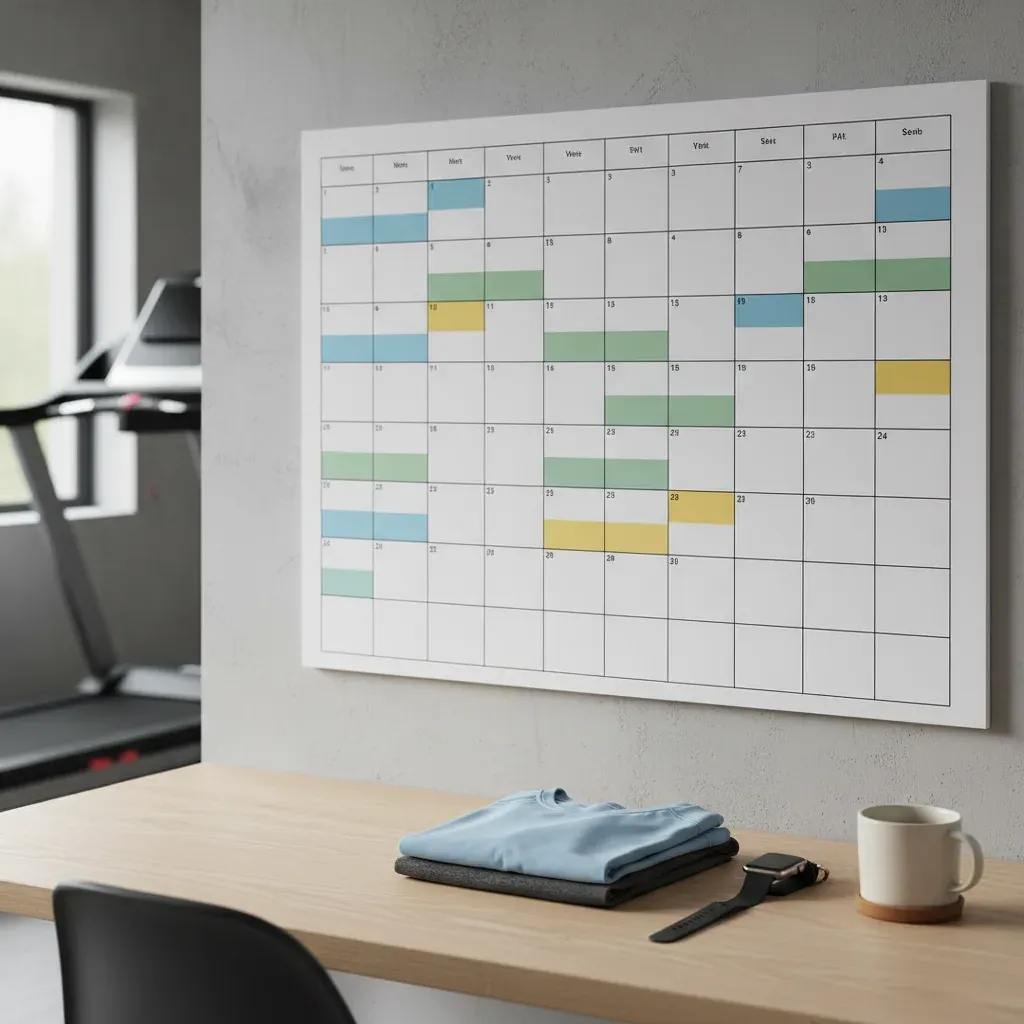
Improvisation is the enemy of progress, especially when the available time is limited. Weekly planning is the most effective way of guaranteeing continuity in your training despite a full professional diary. It means blocking out your training slots at the start of the week, exactly as you would a meeting or a client appointment.
In practice that means identifying, every Sunday evening or Monday morning, the few windows available that week, and then assigning each of them a suitable type of workout (easy endurance, threshold work, active recovery). That anticipation avoids the “I’ll see if I have time” syndrome, which almost always translates into a week with no training at all.
Planning also lets you dose the load across the week better. Someone training three times a week with a good spread of intensities will improve more than someone who does two long weekend outings after five days of inactivity. That is a fundamental principle of endurance training: the body adapts to consistency, not to isolated peaks.
Tools like Slek let you structure that planning intelligently, taking account of heart rate zones, training loads and medium-term objectives. This kind of platform is particularly useful for endurance athletes who want to improve without getting injured, even with limited training time.

Do and don’t
| Do | Don’t |
|---|---|
| Block out your training slots in your work diary at the start of the week. | Make up for a busy week with a long, hard workout at the weekend: that is the surest way to get injured. |
| Accept short workouts as workouts in their own right. | Systematically skip training when a meeting appears: better to shorten it than to cancel. |
| Use the lunch break at least once or twice a week. | Neglect what you eat around midday workouts: a suitable snack before and a balanced meal after are part of the workout. |
| Vary the formats (easy endurance, short intervals, active recovery) to keep motivation up and work different systems. | Ignore the signs of fatigue: someone under professional stress is already carrying a considerable mental load, and the training has to fit around it. |
| Sleep enough: recovery matters as much as the training itself. |
FAQ
How many workouts a week are enough to improve in endurance sport with a full-time job?
Three workouts a week is a solid minimum for improving in endurance, provided they are well spread out and correctly dosed. One easy endurance workout, one specific workout (intervals, threshold) and a long outing at the weekend make a coherent base. Below three, progress is possible but slower. Above four or five for someone very busy (work, young children and so on), the risk of overreaching rises significantly.
How do you stay motivated when the schedule falls apart?
Motivation follows structure, not the other way round. When your work diary runs away with you, training is usually the first thing to give. To avoid that, it helps to set a non-negotiable minimum (two workouts a week whatever happens) and to keep very short formats (20 to 25 minutes) as a fallback. Having a concrete objective a few months out, such as a triathlon or a trail race, also helps you hold your line through the difficult periods.
Can you improve in trail or triathlon with short workouts alone?
Yes, up to a point. Well-targeted short workouts let you maintain and even improve your aerobic qualities, your power at threshold and your running economy. The limits appear mainly for long events (ultra-trail, Ironman), where adapting to prolonged effort requires longer outings. For a half marathon, a short trail race or a sprint or Olympic distance triathlon, a programme built on workouts of 30 to 50 minutes can absolutely get you to the finish and keep you improving.
Building endurance training that lasts despite a full diary
Combining sport with an intense job is not a question of willpower, it is a question of organisation. By accepting that short workouts have real value, by making use of the lunch break and by planning your training slots like professional appointments, it becomes possible to improve consistently even with a diary that has no room left in it.
The essential thing is to build a routine that is robust, adaptable and coherent with your sporting objectives. To go further and structure your endurance training intelligently, Slek offers the tools you need to plan, analyse and improve, whatever your time constraints.
More articles you might like

Balancing work and endurance sport | The practical Slek guide
Balancing work, family and endurance sport can feel like an impossible puzzle. Between busy working days, family life, fatigue and the unexpected, plenty of athletes feel they are always sacrificing something. Yet that balance is no myth if you set a realistic, flexible and sustainable frame. With better organisation […]

A step-by-step guide to preparing your first triathlon
Distance, kit, an 8-week training plan, transitions: follow this step-by-step guide to prepare your first triathlon calmly and avoid the beginner's mistakes.

How to get your long run right: 7 secrets
How do you handle your long run without wearing yourself out? The Slek coaches share 7 practical secrets. Avoid the mistakes and find the right pace.