Taking on a triathlon as a beginner can feel intimidating: three disciplines to string together, transitions to master, a training plan to build. Yet preparing your first triathlon is entirely within reach as long as you organise yourself properly and choose the right format to start with. This guide takes you step by step, from choosing the distance to race day, with a typical 8-week plan, the list of essential kit and the mistakes to avoid at all costs.
Preparing your first triathlon: the beginner’s guide to crossing the finish line
Reading time: ~7 min
- Choosing the right distance for your first triathlon
- The minimum kit for each discipline
- An 8-week training plan for a sprint triathlon
- Transition area and transitions
- Do and don’t
- FAQ
- Crossing the finish line is already a victory
Choosing the right distance for your first triathlon
The first decision is the format. Getting the distance wrong risks discouraging you before you even reach the start line.
The distances work like T-shirt sizes, from XS to XXL, and roughly speaking each one doubles the last.
The XS format (400 m swim, 10 km bike, 2.5 km run) is perfect for a first experience. It lets you discover all three disciplines and the transitions without excessive pressure on the volumes.
The S or sprint format (750 m swim, 20 km bike, 5 km run) is the reference distance for a first serious triathlon. It takes about 8 weeks of preparation at 4 workouts a week, which is 3 to 4 hours of training a week.
The M or Olympic format (1,500 m swim, 40 km bike, 10 km run) is possible for beginners who already have a good base in one of the three sports. It takes about 2 months of preparation and 5 to 10 hours of training a week.
For an L or an XXL (Ironman), count on 3 months at more than 10 hours a week, and 4 to 6 months at at least 15 hours a week respectively. Those formats are clearly not first-season objectives.
For adults starting out, my recommendation would be the sprint: the race is not won on the transitions, but it stays accessible enough to prepare without sacrificing your personal life.
For a first taste you can also enter as part of a relay team of three, each person taking one of the disciplines.
The minimum kit for each discipline
You do not need to spend thousands to do a first triathlon. Here is what is genuinely essential.
The ideal outfit is a trisuit (a short one-piece worn under the wetsuit that stays comfortable across all three disciplines). For an XS or a sprint, though, swimwear can be enough if you can put up with a little less comfort: a bit of petroleum jelly around the chafing areas (between the thighs, for instance) can help you finish without irritation.
Bring a race belt too if you have one, since your number has to be visible behind you on the bike and in front of you on the run. In the minimalist option (swimwear and so on), you can pull a T-shirt on after the swim and pin a number front and back with safety pins (not supplied).
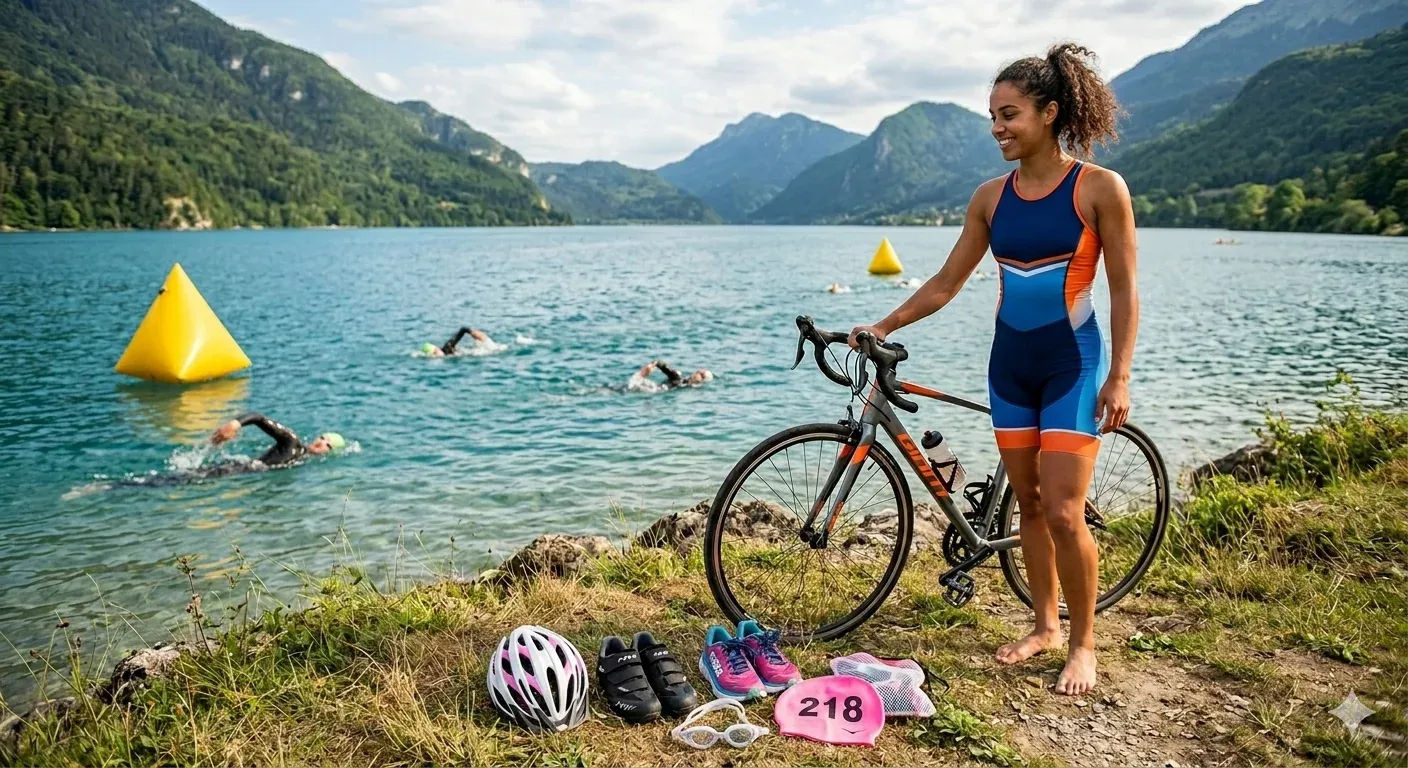
Swimming
The complicated part is that you may well need a wetsuit. It is compulsory if the water is below 16 °C, and banned from 24.5 °C. Between the two you can do as you like, but it helps most swimmers, and frankly, if you spend 15 minutes in water at 17 °C you will leave energy in there that you might miss later.
Organisers sometimes hire them out, so ask.
Otherwise, as at the pool, you need your goggles and a swim cap. Note that, unlike SwimRun, pull buoys and hand paddles are banned.
Cycling
A helmet is compulsory with no exceptions, and you have to wear it, with the strap fastened, from before you take your bike until the moment you rack it at the end.
Oddly enough, a helmet is banned on the run: you have to take it off after the bike.
A bike (road or mountain bike) in good condition is enough to start with. Bring a spare inner tube and the tools to change it.
Note that bar end plugs are compulsory: you cannot enter the transition area if your handlebars are open at either end (at worst, a few turns of strong tape will get you out of trouble if you discover this on the morning of the race).
Running
If you are used to running there are few surprises here. Triathletes often run without socks to save time in transition, but do whatever suits you. You will probably see elastic laces; over an XS or a sprint, if the ground is not too rough, you can simply leave your shoes loose enough to slip on without tying them. You can also put a little talc in them so they slide on more easily.
An 8-week training plan for a sprint triathlon
The logic of the progression
The point of the 8 weeks is not to turn you into a finished athlete, but to get you to the start in good shape, uninjured and with enough confidence. Consistency counts for more than intensity. Start with 2 or 3 workouts a week (one per discipline) if you are starting from nothing, then build gradually to 4 or 5.
Plan a lighter week every 3 or 4 weeks so your body can absorb the load. And schedule at least one complete rest day every week, non-negotiable.
An example of a typical week (weeks 3 to 6)
| Day | Discipline | Content |
|---|---|---|
| Monday | Rest | Complete recovery |
| Tuesday | Swimming | 30 min, intervals of 25 to 100 m with rest |
| Wednesday | Running | 30 to 40 min, alternating jogging and walking |
| Thursday | Cycling | 45 to 60 min, flat route, comfortable pace |
| Friday | Swimming | 30 min, technical work |
| Saturday | Bike + run | 45 min on the bike then 10 to 15 min of easy running |
| Sunday | Strength work or active rest | Core work, lunges, stretching |
What matters in each discipline
In swimming, work on technique before trying to increase the distances. Short intervals of 25 to 100 metres with recovery phases are far more effective than exhausting yourself over continuous lengths. The initial aim is simple: being able to swim the race distance without stopping.
On the bike, choose flat routes and hold a pace where you can still talk. There is no question of going into the red in training at this stage. The base endurance is built at low intensity.
In running, alternating jogging and walking works very well for beginners. A typical progression: 20 times 1 minute of jogging followed by 1 minute of walking, then 10 times 3 minutes of jogging for 1 minute of walking, and so on over several weeks.
The bike-run brick, the key to the transitions
The “jelly legs” feeling after the bike surprises almost every beginner. In my first triathlon I looked down at the start of the run to check my legs were still there. To deal with it, bring brick workouts in from the fourth or fifth week: finish your bike ride and go straight into 5 to 15 minutes of easy running. Your body adapts to that muscular transition quickly.
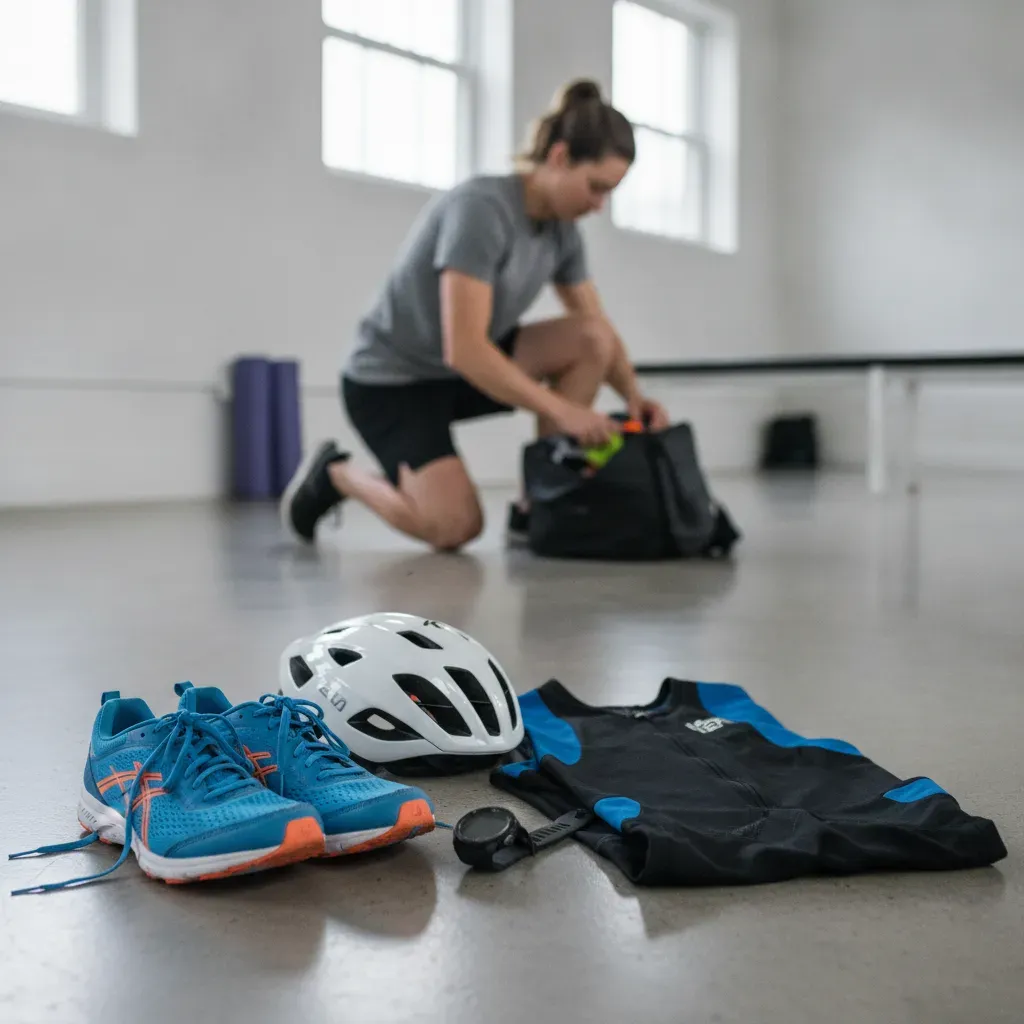
Transition area and transitions
A triathlon strings together three disciplines: swimming, cycling, running. Between them are the transitions (T1 before the bike, T2 after). They happen in a transition area enclosed by barriers, where your bike is looked after by the organisers.
Riding your bike inside the transition area is forbidden: an official marks a line beyond which you can get on your bike, and before which you have to get off at the end.
Before the start you have to go and lay your kit out in the transition area. The entrance is guarded by officials who check your equipment (working brakes, helmet with a strap, bar end plugs).
Organisers often give two times: “transition opening” is when you can start laying out your kit, and “transition closing” is the point after which it is too late. Arrive after that and you will be watching the race rather than racing it.
For your first few races, aim to get into the transition area as soon as it opens: it saves you a lot of stress, and you can then go and relax by the water and warm up once everything is ready.
Watch out, though: between transition closing and the start, organisers often hold a briefing, and that is no longer the time to be warming up.
You can go back out with your running shoes and put them back at the last minute: it is entering with your bike that the officials watch.
If you do not have a wetsuit, favour a dry warm-up so you do not get cold during the briefing (unless it is very hot, of course). If you do have one, be careful not to sweat before putting it on, because it becomes very hard to pull on when you are wet.
Transitions are often neglected in training, even though they can win or lose you several minutes.
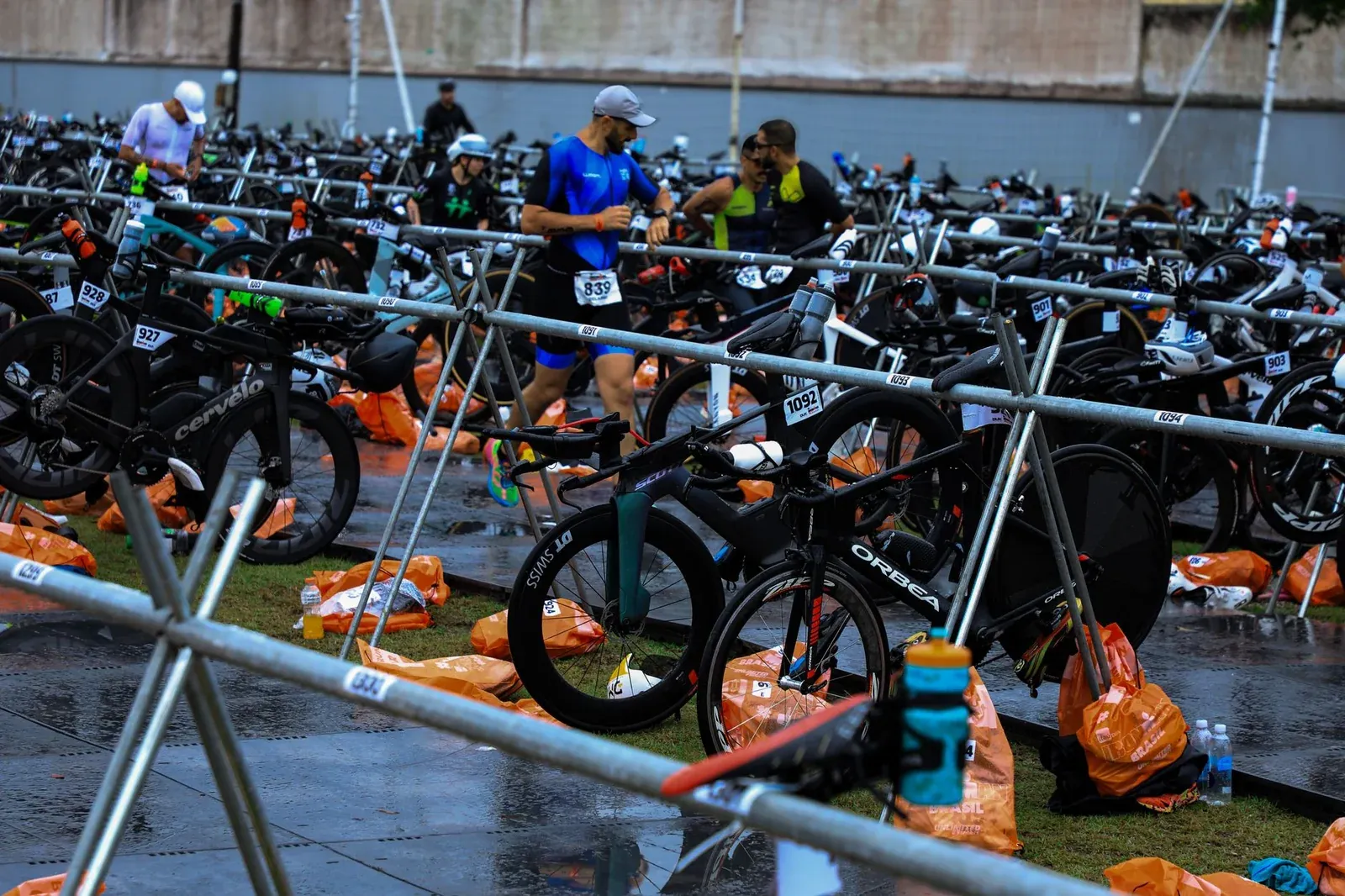
Organise your transition space methodically before the race: lay your things out in the order you will use them, find the entrance and the exit of the zone. As you set up, do not hesitate to ask an official for help and tell them it is your first time: there are precise rules you cannot guess, and breaking them could cost you a penalty.
Spend a few minutes visualising each step: getting out of the water, taking the wetsuit off, putting on the helmet and the race belt, leaving the area with the bike in your hand, then the reverse at T2. That mental rehearsal considerably reduces the stress and the number of things you forget.
Do and don’t
Do
Respect at least one rest day a week. Work on swimming technique before increasing the distances. Practise going from the bike straight into the run. Read the event’s athlete guide several days beforehand. Sort out your food and hydration from 48 hours before the race. On the day, in the water, do not rush: settle into your stroke and get plenty of oxygen by breathing every two strokes, at least as far as the first buoy.
Don’t
Jump straight to 6 or 7 workouts a week from the start. Neglect strength work (core, lunges, shoulders). Set off too fast on the day on a rush of adrenaline. Test new kit or new nutrition on race day. Underestimate the fatigue that comes from stringing three disciplines together. Force yourself to breathe every three strokes as you would at the pool.
FAQ
How long does it take to prepare for a first sprint triathlon?
For a sprint triathlon, 8 weeks of preparation is enough if you already have some sporting base. If you are starting from nothing in all three disciplines, allow 10 to 12 weeks so you can progress without getting injured. The essential thing is to be able, before the day, to swim the distance without stopping, hold a moderate pace on the bike and run 5 km.
Do you have to be a very good swimmer to do a triathlon?
No. Swimming is often the discipline that worries beginners most, but for an XS or sprint format you simply have to be able to swim the distance continuously. You do not need perfect technique. Concentrate on your breathing and your rhythm rather than your speed. If you struggle, you can roll onto your back or hold on to a safety buoy without being disqualified.
How do you handle nutrition before the race?
Nutritional preparation starts 48 hours before the event. Gradually increase your carbohydrate intake to build your energy stores, drink regularly and avoid foods likely to upset your digestion (fatty, very fibrous or anything you are not used to eating). On the morning of the race, have an easily digested meal 2 to 3 hours before the start.
What budget should you plan for a first triathlon?
Generally speaking, people do not enter a triathlon without a bike (road, mountain or gravel) or running shoes. The real extra kit is the trisuit, the wetsuit and the race belt. As we have seen, only the wetsuit can be compulsory, and you can sometimes hire one. There is no need to invest in that specific kit before you have confirmed that the sport is for you.
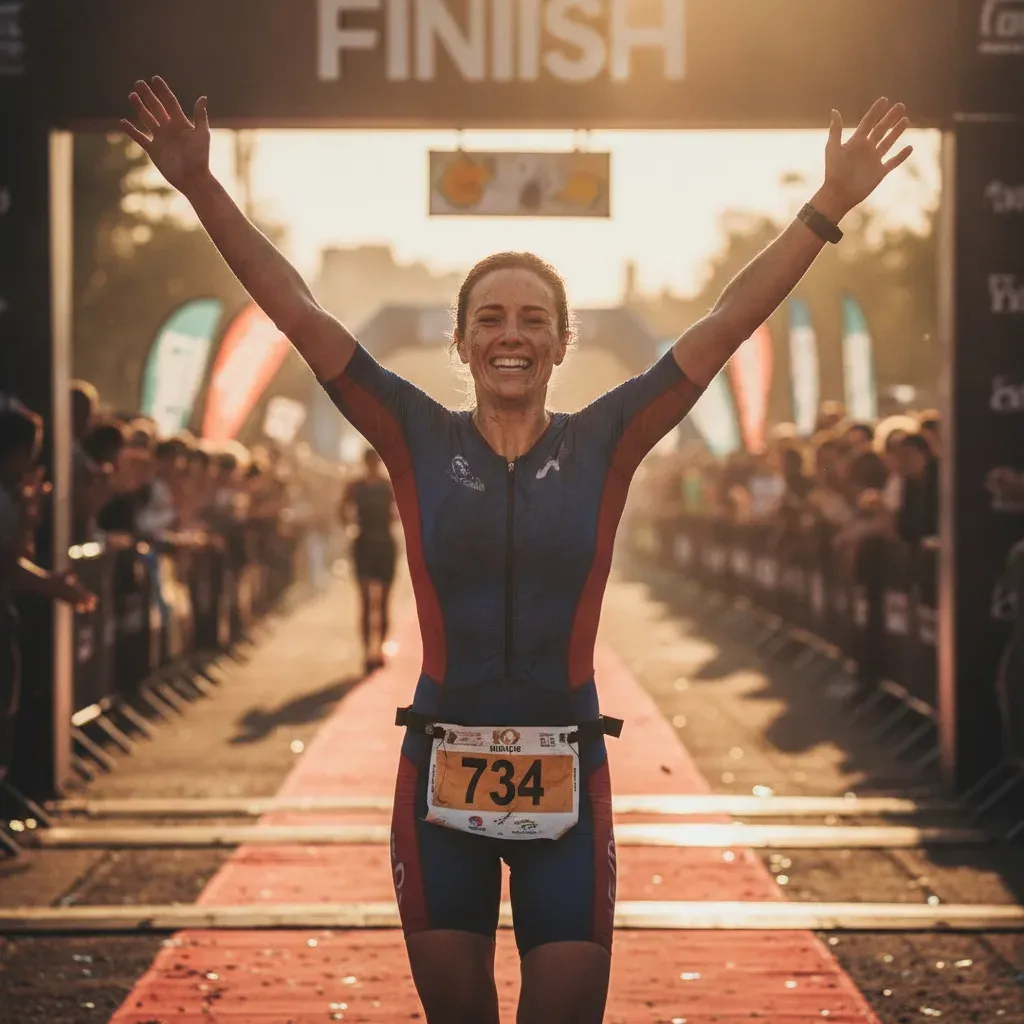
Crossing the finish line is already a victory
Preparing your first triathlon does not take an elite athlete. It takes consistency, a structured plan, common sense about recovery and a distance that matches your real level. By following an 8-week progression, working on the bricks and arriving at the start with your kit ready and your head organised, you have everything you need for a first experience that goes well.
If you are looking for a tool to structure your training, follow your workouts and improve intelligently in endurance sport, Slek was built to be with you at every step.
More articles you might like

How to plan your triathlon season | The Slek guide
Planning your triathlon season is not just about filling a calendar with workouts and race numbers. It is about organising your progress so you arrive in shape at the right moment, without exhausting yourself or spreading yourself thin. Think the season through in advance and you gain clarity, your training makes more sense and you reduce […]
Slek: the app for triathlon
Triathlon is about as complete a sport as you can find, and about as demanding. Between swimming, cycling and running you have to juggle the training and manage the recovery. That is where a planning and analysis app earns its place, as a real asset in your preparation and your training records. Slek is the app you […]

Sport and work: fitting endurance training into your diary
Struggling to combine sport and a demanding job? Follow this guide to fit endurance training into a packed schedule, with simple steps.