Just before an event, stress is not necessarily the enemy: in the right dose it helps you mobilise, concentrate and act. The problem starts when it spills over and disturbs your breathing, your thoughts, your clarity or your sensations. Managing pre-race stress therefore means working on the mental side with as much seriousness as the physical.
We are going to look at five simple, concrete and effective techniques for finding calm without losing intensity. The aim is not to remove all pressure, but to turn that tension into useful energy. For an athlete as much as for a coach, that is often where the difference lies between enduring the event and taking it on in control.
5 mental preparation techniques for managing pre-race stress
Reading time: ~6 min
Contents
- Why managing pre-race stress really changes your performance
- Technique 1: controlled breathing to bring the tension down
- Technique 2: positive visualisation to prepare the brain to succeed
- Technique 3: personal rituals for getting into your bubble
- Technique 4: internal dialogue to reframe the pressure
- Technique 5: the body scan and muscular release for getting your freedom back
- How to combine these techniques into a pre-race routine
- Do and don’t before a race
- Common mistakes when trying to handle pressure better
- FAQ
- In summary
Why managing pre-race stress really changes your performance

What stress does to body and mind
Pre-race stress acts on the body and on the brain at once: raised heart rate, stiffened posture, disturbed coordination, muddled decision-making.
In endurance sports (athletics, trail, triathlon, cycling, swimming, cross-country skiing), those effects can cost you dearly: setting off too fast, misreading your sensations, or losing focus.
Finding the right level of activation
Stress is not always negative, though: it signals that this matters and can raise the level of activation you need for the effort. The whole question is stopping it becoming a mental overload. For that, psychological preparation has to have its place in your pre-race routine. A well-trained athlete who is badly prepared mentally can miss their performance; the reverse is equally true, of course.
Technique 1: controlled breathing to bring the tension down
Why the breath works so fast
Breathing is one of the fastest ways of calming a physiological runaway. Under stress it becomes short, high and irregular, which the brain reads as an alarm signal. Taking back control of your breath sends the opposite message: safety.
How to use it before the event
The simplest method is box breathing: breathe in through the nose for 4 s, hold for 4 s, breathe out through the mouth for 4 s, stay with empty lungs for 4 s. Repeat the cycle for 5 min, ideally 15 to 30 min before the race. Excessive activation comes down without going soft, so you stay ready but clearer inside. Coaches can build the exercise into the mental warm-up: the athlete finds calm and enters a repeatable routine.
Technique 2: positive visualisation to prepare the brain to succeed
Visualise a credible execution
Visualisation is not only seeing yourself win; it is mentally rehearsing the right actions, the useful sensations and credible scenarios at the same time. The brain gets used to the situation.
Make the exercise concrete and sensory
Close your eyes for 5 min and picture one or two key moments of the race precisely (a controlled start, your pace, your posture, the final effort), the transitions in a triathlon, entering the water in a swim. The more sensory the visualisation (sight, sound, foot strike, breathing, fluidity), the more it reduces uncertainty, which is the main fuel of stress. The exercise stays effective as long as it stays realistic: there is no point imagining a “perfect” race that nobody would believe. Better to visualise a solid, committed execution to build confidence.
Technique 3: personal rituals for getting into your bubble
Creating a familiar frame
Rituals create a familiar frame in an uncertain context. They bring your attention back to what you can control: a gesture, a particular piece of music, a fixed order to your warm-up, laying out your kit. The point is not superstition but grounding. Some athletes have used the same rituals for years to find their performance state. In endurance sports it can be a discreet sequence: breathing, getting moving, refocusing, going over the plan.
What a good ritual gives you
- Fewer outside distractions
- Attention aimed at the process
- Continuity between training and racing
- A stable state of concentration
Ideally you build the ritual in training; race day is no time to innovate.
Technique 4: internal dialogue to reframe the pressure
Spotting the thoughts that amplify stress
Stress usually comes with a brutal internal commentary (“I’m not ready”, “I’m going to crack”). That mental flow reinforces the threat and pulls attention away from useful actions. The work consists of spotting those automatic thoughts and replacing them with functional ones.
Prepare some refocusing phrases
For example: rather than “I’m going to fail”, tell yourself “I’m staying focused on my plan”. Instead of “I’m too stressed”, frame it as “my body is getting ready to perform”. The aim is not to lie to yourself but to take back control of the interpretation.

Prepare three short phrases to use before the start, such as:
- I am ready
- I breathe and I stay in my plan
- I control what I can control
Technique 5: the body scan and muscular release for getting your freedom back
Detecting useless tension
Stress settles in the body too: a clenched jaw, high shoulders, a tight neck, gripped hands. A stiff body uses more energy and limits how fluidly you move.
Release without losing commitment
The body scan means going mentally through the areas from head to toe to spot the tension. You can then contract a muscle group for 5 s and release for 10 s. In 3 to 5 min you recreate some internal space: sharper sensations and better movement economy, which is particularly valuable over long distances.
How to combine these techniques into a pre-race routine
A simple sequence, tested in training
The most effective routines combine several tools. A sequence of 15 to 20 min is usually enough, and it should be tested in training so it becomes automatic.
| Moment | Action | Duration |
|---|---|---|
| Start | Controlled breathing | 5 min |
| Then | Visualisation (1-2 key moments) | 5 min |
| Then | Body scan and release | 3-5 min |
| Just before | Personal ritual and refocusing phrases | 3-5 min |
Do and don’t before a race
The right habits
Do: practise these techniques outside races so they become familiar; keep the instructions simple; come back to your breath, your sensations and your plan; accept a normal amount of stress.
The traps to avoid
Don’t: change your whole routine at the last minute; use guilt-inducing internal dialogue; confuse excitement with catastrophe; wait until you feel bad before starting to work on the mental side.
Common mistakes when trying to handle pressure better
Three common errors
- Believing that a high-performing athlete should be completely calm: a certain level of activation is useful, and aiming at “zero stress” is counterproductive.
- Focusing only on the result: the more your attention stays on the placing, the time or what other people think, the more the pressure rises. Coming back to the process helps a great deal.
- Neglecting mental training on the assumption that experience is enough: even experienced athletes need tools for staying clear-headed under pressure.
FAQ
How long before a race should mental preparation start?
Ideally several weeks in training. For the immediate routine, 15 to 30 min before the event is a good reference.
Do these techniques suit every sport?
Yes, provided you adapt them. The needs differ between a 1500 m, a long-distance triathlon and an open water race, but the principles hold.
What if the stress is still too strong?
If stress becomes overwhelming or repeats, working with a mental performance coach can help you go deeper into emotions, confidence and thought patterns.
Can a coach put this in place without being a psychologist?
Yes, as long as they stay within a simple, concrete and respectful frame. This is not therapy; it is helping the athlete structure their performance routine.
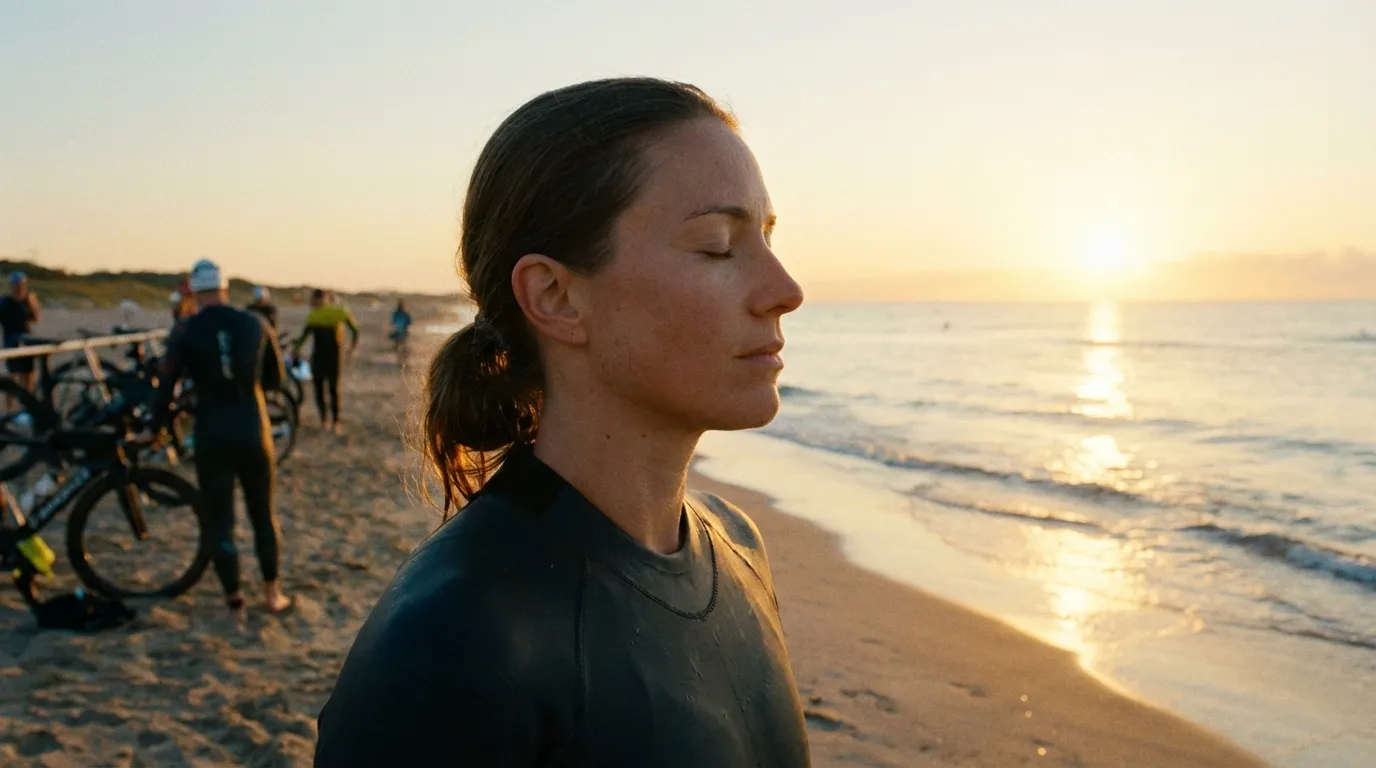
In summary
A simple base for handling pre-race stress better
Performance does not depend only on physical condition or on the training plan: it also rests on your ability to stay clear-headed, relaxed and committed when the stakes rise. Breathing, visualisation, ritual, internal dialogue and physical release make a solid base for living with the pressure and performing more accurately.
As a coach, with Slek, the app for coaches, you can add mental preparation workouts to your athletes’ programmes. It is also an excellent platform for supporting them on the physical and technical side.
More articles you might like
A step-by-step guide to preparing your first triathlon
Distance, kit, an 8-week training plan, transitions: follow this step-by-step guide to prepare your first triathlon calmly and avoid the beginner's mistakes.

Sport and work: fitting endurance training into your diary
Struggling to combine sport and a demanding job? Follow this guide to fit endurance training into a packed schedule, with simple steps.

Tapering before a race: gaining freshness without losing your fitness
Tapering reduces fatigue before a race without losing what your preparation built. Volume, intensity, frequency, a two-week plan: the guide to arriving fresh on race day.