Amateur or elite, knowing how to dose the intensity of your training is essential if you want to improve without getting injured. Quantifying training load is the tool for that. Among the most widely used methods, TRIMP (Training Impulse) and the Foster model let you measure intensity and understand your body’s response better. Let us take a look at both approaches, and at how they can help you get more out of your training.
What is TRIMP?
TRIMP, or Training Impulse, is a method that quantifies training load from the intensity and the duration of your workouts. The calculation is fairly simple, but very effective for tracking your workload over time.
How does it work?
TRIMP is built on your heart rate during the effort. In practice, you measure your heart rate while training and combine it with how long the effort lasted, which gives you a figure that reflects the overall intensity of the workout.
The basic formula is simple: TRIMP = duration of the workout (in minutes) × average heart rate
In a more advanced version, TRIMP assigns specific values to different heart rate zones (rest, low, moderate, high) and multiplies them by the time spent there, which gives a more accurate estimate of the workload.
The advantages of TRIMP
It is a simple method, and it is open to everyone. With nothing more than a heart rate monitor you can track the intensity of your training and watch how your body responds over time. If you are after something quick and effective, TRIMP is an excellent choice.
It does have its limits, though. Because it is based on heart rate, it does not always reflect the real intensity of an effort: on very short sprints, for instance, the heart has no time to climb, and when you are very tired your heart may refuse to climb as high as usual. It also depends on measuring your heart rate accurately (do not take it at the wrist), which is not easy to guarantee in swimming.
The Foster model: a more subjective approach
The Foster model goes a step further, combining not only the duration and the intensity of the exercise but also your perception of the effort. It gives you a fuller picture of your training load, because it takes into account how the effort actually felt.
How does it work?
Here you use the rating of perceived effort, or RPE (Rating of Perceived Effort), which runs from 1 to 10. The more tired you feel and the harder the effort seems, the higher your RPE score. You then multiply that score by the duration of the workout to get the training load.
Foster training load = duration (in minutes) × intensity (on the RPE scale)
This lets you factor in how you feel and adapt your training to your physical and mental state.
The advantages of the Foster model
The model is more flexible and it takes your perception into account, which matters a great deal if you want to avoid overloading your body without noticing. It also helps you manage fatigue and adjust to the shape you are in on any given day. On a day when you are tired, you can reduce the intensity without giving up the benefit of the workout.
One caveat: the method relies on your ability to judge how you feel. If you are not used to listening to your body, being precise in your ratings can be difficult.
TRIMP vs Foster: which load model suits me?
Simplicity
TRIMP is the perfect choice if you want something simple and fast. If you are after an objective way of tracking your intensity, TRIMP is ideal.
Accuracy
The Foster model offers a more complete and personal approach, because it includes your perception of the effort. That helps you adapt your training to the physical and mental shape you are in. Foster showed an excellent correlation between his subjective load and other, objective ways of measuring effort.
Adaptability
The Foster model adapts better to your condition on the day. You can adjust your effort according to how you feel, which is a real advantage if you want to avoid pushing too hard. TRIMP, on the other hand, stays firmly anchored in objective heart rate measurements and can be less accurate when your physical or emotional state varies.
They go together
If you want a broad and nuanced view of your training load, the Foster model has the edge. TRIMP concentrates on the physiological side and can feel a bit narrow for anyone who wants a more human, more subjective approach. In the end, the two complement each other nicely.
How does it work in Slek?
In your Slek app you can use Foster, TRIMP or both.
You do have to pick one of them for the load displayed on your season timeline. But you can see both, side by side, in all your statistics.
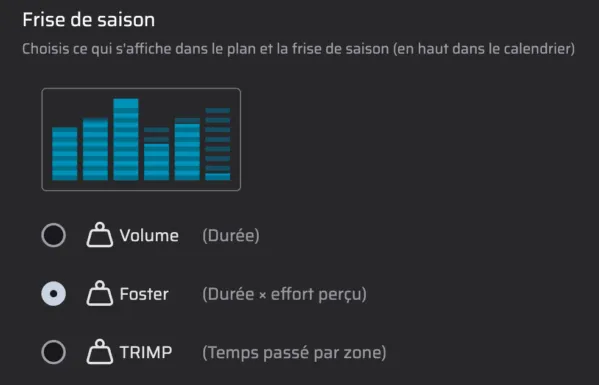
Choosing between TRIMP and Foster for the completed load shown on your season timeline
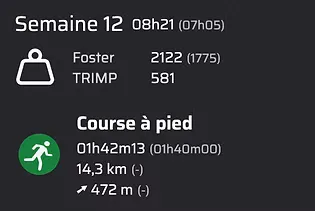
Both methods shown in your weekly totals
In conclusion: over to you
Whichever model you settle on, TRIMP or Foster, what matters is understanding the intensity of your workouts and adapting accordingly. Both methods have their strengths, and they can even be combined for a sharper picture of your training load. The point is to make your efforts count, keep overtraining away and get the most out of your performances.
So, ready to quantify your training and give your progress a push?
More articles you might like
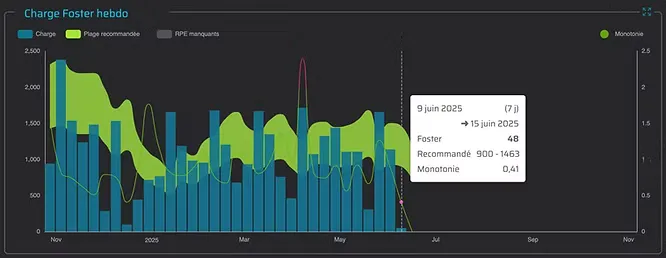
Slek: analysing weekly training load with the Foster method
Training load analysis in Slek, explained from top to bottom.

The 10 signs of overtraining you need to recognise
Performance dropping, or fatigue that will not lift? Learn to spot the 10 signs of overtraining and recover before the damage sets in.

HRV | Heart rate variability and training
Heart rate variability (HRV) has become an increasingly useful reference for understanding what the body is genuinely able to take day to day. It is not about following one more number on a watch or an app: it is above all a way of reading your recovery […]