How does the Foster method calculate training load?
The Foster method assesses training load by combining:
-
the duration of the workout,
-
with the rating of perceived exertion (RPE)
Load = duration (in minutes) × RPE
That gives you a subjective but very useful measure of the impact a workout had on the athlete.
If you want to go further, we wrote a fuller article on the Foster method a while back: TRIMP vs Foster: which training load model should you choose?. Here we concentrate on analysing Foster load, but in Slek the TRIMP load chart works in exactly the same way.
Analysing Foster training load
Now to the analysis itself, which Slek lays out visually:
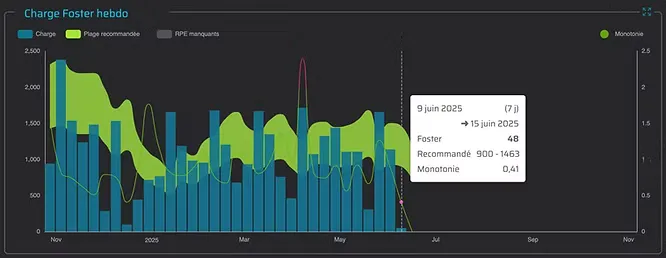
In this example we can see:
November to January: training load falling
The load drops below the recommended zone (the green band): see the article How is the recommended load zone calculated in Slek? The ACWR method.
If that drop was not deliberate and controlled (a load reduction before a race), it can lead to a loss of adaptation to effort.
Monotony is low (see the article Training monotony in sport)
Good points: several weeks in the green target zone.
Bad points: an irregular deload, with a spike between two low-load weeks
January to February: training load rising gradually
Raising the load gradually after a break in activity (injury, off-season, illness) limits the risk of injury.
The monotony curve is fairly regular.
Good points: several weeks in the recommended range.
Bad points: a lack of regularity → possible chronic stress, badly managed recovery or an increased risk of injury
February to April: irregular training load
Overall the load sat in the recommended range.
One spike well above it, with monotony in bright red: a high risk of injury or of a poor performance. Spikes like this should be avoided, or paid for afterwards with extra attention to recovery (sleep, hydration, nutrition).
Good points: several weeks in the recommended range, a better load/recovery balance. A moderate and more regular monotony curve.
Bad points: several deload weeks in a row. That is a problem if they are not a normal part of the preparation.
April to June: general improvement
Better stability: most of the bars stay in or near the green zone.
A moderate and more regular monotony curve
Good points: several weeks in the recommended range, a better load/recovery balance. A moderate and more regular monotony curve.
Bad points: remember to build deload weeks in between several weeks of high load.
Training load: what to keep an eye on
-
Aim for consistency: stay in the green zone (roughly 3 weeks out of 4, or 2 out of 3).
-
Avoid sudden load spikes
-
Watch monotony: keeping it under 2 limits the risk of injury
-
Fill in your RPE every time, otherwise there is no way to calculate load with the Foster model
Working with a coach is still the best way to progress in a way that is personal and sustainable.
“Data doesn’t make decisions, people do.” – Gabbett, T.J.
Sources:
Gabbett TJ. The training–injury prevention paradox: should athletes be training smarter and harder? Br J Sports Med. 2016;50(5):273–280.
Foster C. Monitoring training in athletes with reference to overtraining syndrome. Med Sci Sports Exerc. 1998;30(7):1164-1168.
Gabbett TJ. The training–injury prevention paradox. Br J Sports Med. 2016
More articles you might like

TRIMP vs Foster: which training load model should you choose?
Amateur or elite, knowing how to dose the intensity of your training is essential if you want to improve without getting injured. Quantifying training load is the tool for that. Among the most widely used methods, TRIMP (Training Impulse) and the Foster model let you […]

The 10 signs of overtraining you need to recognise
Performance dropping, or fatigue that will not lift? Learn to spot the 10 signs of overtraining and recover before the damage sets in.

HRV | Heart rate variability and training
Heart rate variability (HRV) has become an increasingly useful reference for understanding what the body is genuinely able to take day to day. It is not about following one more number on a watch or an app: it is above all a way of reading your recovery […]