You train regularly, you are improving, and then suddenly everything seizes up. Your legs are heavy, your times stall, the slightest effort becomes a chore. What you are feeling may not be a simple bad patch. Overtraining is a very real syndrome, and it affects amateurs and experienced athletes alike, particularly in endurance disciplines like trail running, triathlon and cycling. Recognising the early signs is what gives you the chance to act before the damage becomes lasting.
Overtraining: 10 signs that should put you on alert straight away
Reading time: ~6 min
Contents
- What overtraining actually is
- The 10 signs of overtraining you should not ignore
- Telling overtraining apart from ordinary tiredness
- What to do when the signals pile up
- FAQ
- Overtraining is prevented by controlled recovery

What overtraining actually is
A definition
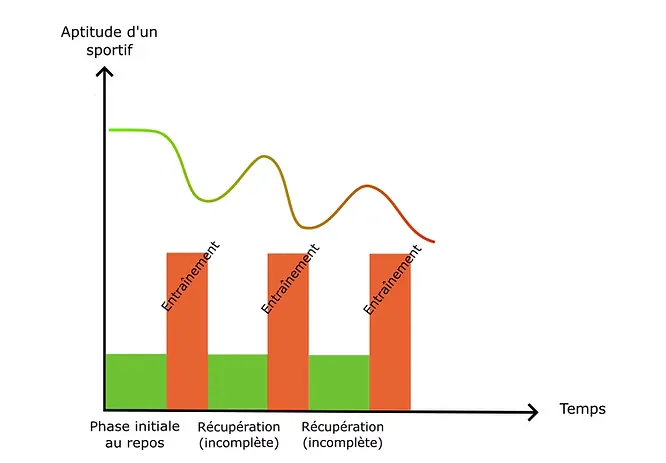
Sports medicine defines overtraining as a state of chronic fatigue resulting from a prolonged imbalance between training load and the body’s capacity to recover. It is not simple, passing tiredness but a deep disturbance affecting the physical, hormonal and psychological systems.
Overreaching versus overtraining syndrome
It matters to distinguish two levels. Overreaching is an accumulation of stress that brings a short-term drop in performance, reversible in a few days to a few weeks with rest. Overtraining syndrome involves a far more lasting disturbance, and recovering from it can take several weeks or even several months. The central criterion is a persistent drop in performance, still detectable even after an extended recovery phase.
The main causes of overtraining
The causes are varied. Training volume or intensity that is too high, an absence of periodization, loads that rise too quickly (beyond the recommended range of the acute to chronic workload ratio, ACWR), insufficient sleep, an unbalanced diet, or high stress at work and at home can all help tip the balance.
The 10 signs of overtraining you should not ignore
Fatigue that persists despite rest
This is often the first signal. Unlike the normal tiredness after a workout, the fatigue linked to overtraining does not go away with a night’s sleep or a rest day. It settles in, accumulates and eventually becomes a permanent background state. General exhaustion, muscular weakness and a lack of energy in daily life are its most visible expressions.
An unexplained drop in performance
You train as much as ever, or more, and your results go backwards. Times get slower, power falls, speed drops. That decline despite continued training is one of the most reliable indicators of overtraining syndrome. It persists even after a few days of rest, which is what distinguishes it from ordinary tiredness.
Muscle and joint pain that will not go away
Soreness is part of training. But when it becomes permanent, when muscles stay painful between workouts and joints are regularly tender, it is a sign that the body is not getting time to repair itself properly. Frequent headaches can accompany this state too.
An abnormally high resting heart rate
Resting heart rate is a valuable marker of how well you are recovering. A rise of 5 to 7 beats per minute compared with your usual value, measured in the morning before getting up, can indicate that your body is under chronic stress. Following that indicator regularly lets you catch the warning signs well before the more severe symptoms appear.
Disturbed sleep
The paradox of overtraining is that it disturbs precisely what should allow recovery. Difficulty getting to sleep, frequent waking in the night, unrefreshing sleep despite adequate hours: these are characteristic of the syndrome. Yet an athlete in a period of intensive training needs 7 to 9 hours of sleep a night for muscular and nervous regeneration.
Irritability and emotional instability
Overtraining does not stop at the body. It affects mood deeply. Unusual edginess, mood swings, being quicker to take offence in personal or professional relationships: these psychological signals should be taken seriously. They reflect a disturbance of the autonomic nervous system and of hormonal balance.
A loss of motivation to train
What you used to love doing becomes a burdensome obligation. The urge to put your shoes on or get the bike out disappears. The pleasure of the effort, which up to now was a powerful engine, gradually fades. This loss of motivation is not weakness of character: it is a biological signal your body is sending to ask for rest.
Anxiety or depressive signs
In the most severe forms, overtraining can develop into anxiety or symptoms close to depression. Rumination, a feeling of emptiness, a loss of interest in usual activities beyond sport: these call for particular attention and a medical consultation.
Greater vulnerability to infection and injury
An overtrained athlete falls ill more often. Repeated colds, frequent ear, nose and throat infections, slower healing: these follow directly from a weakened immune system. At the same time the risk of injury rises appreciably, with more tendinitis, sprains and stress fractures linked to repeated micro-traumas in a body that has had no time to regenerate.
Hormonal disturbances
Overtraining brings biological and hormonal disorders that are not always immediately visible. In women, disturbances of the menstrual cycle can appear. Imbalances in the cortisol axis and in sex hormones have been observed in confirmed cases. Blood tests can reveal these disturbances where there is clinical suspicion.

Telling overtraining apart from ordinary tiredness
| Criterion | Normal tiredness | Overreaching | Overtraining |
|---|---|---|---|
| Duration | A few hours to 1 day | A few days | Several weeks to months |
| Recovery | After 1 night’s sleep | After a few days’ rest | Long and gradual |
| Performance | Slightly affected | Short-term drop | Persistent drop |
| Mood | Stable | Slight irritability | Anxiety, loss of motivation, depressive signs |
| Injuries | Rare | Moderate risk | High risk |
Diagnosing overtraining rests on questioning the athlete, analysing the training load and the wider context of their life, and observing a persistent drop in performance despite rest. Exercise tests, heart rate monitoring and blood work can complete the assessment. If you are in doubt, or if symptoms settle in over time, seeing a sports physician remains the right move.
What to do when the signals pile up
The first step is simple, but often hard for an athlete to accept: reduce or stop training. Depending on the severity, a few days of rest may be enough in cases caught early. For more severe forms with psychological involvement, recovery can take several months. Many specialists recommend a complete stop of 2 to 4 weeks in confirmed cases, followed by a very gradual restart at low intensity to begin with.
Coming back should go hand in hand with a full review of your planning. Respecting progression (keep an eye on ACWR), building in structured recovery phases, improving sleep quality, rebalancing your diet with attention to magnesium, iron, potassium and vitamins: these are all concrete levers for finding a lasting balance again. Relaxation techniques such as meditation or conscious breathing also help with overall stress.
Prevention also runs through day-to-day self-monitoring. Keeping a training log where you note volume, intensity, how you felt, your sleep quality and your mood lets you spot drift before it becomes a problem. Watching your resting heart rate regularly is one of the simplest and most reliable tools you have.

FAQ
Does overtraining only concern elite athletes?
No. Overtraining can affect any athlete at any level. Amateurs are sometimes more exposed, because they often combine work and family commitments with a high training load, without always having the guidance needed to adjust it.
How long does it take to recover from overtraining?
Recovery time depends on how severe the syndrome is. In mild cases caught early, 3 to 4 days of rest can be enough. Where there is an associated injury such as a stress fracture, expect 2 to 3 weeks of complete rest. For severe forms with marked psychological effects, recovery can stretch over several months.
How can I monitor my recovery day to day to avoid overtraining?
Measuring your resting heart rate every morning is a simple and effective indicator. A steady rise compared with your baseline should alert you. Keeping a training log that includes how you feel (fatigue, mood, sleep quality, aches) also lets you spot the trends before symptoms get worse.
Overtraining is prevented by controlled recovery
Overtraining is not inevitable. It is above all the result of an imbalance between what you ask of your body and what you give it to recover. By learning to read the signals your body sends you, and by respecting the principles of gradual progression and recovery, you give yourself the means to improve over the long term without wearing yourself down.
If you want to go further in tracking your training and your load and recovery indicators, Slek is there to help.
More articles you might like

HRV | Heart rate variability and training
Heart rate variability (HRV) has become an increasingly useful reference for understanding what the body is genuinely able to take day to day. It is not about following one more number on a watch or an app: it is above all a way of reading your recovery […]
Getting the most out of training: preventing overtraining with proper monitoring
How to spot overtraining and stay clear of it. Slek can help!

Active recovery: a guide to regenerating better
Understand how active recovery helps your body regenerate after an effort. This complete guide sets out the most reliable methods.