Heart rate variability (HRV) has become an increasingly useful reference for understanding what the body is genuinely able to take day to day. It is not about following one more number on a watch or an app: it is above all a way of reading your recovery state better, anticipating fatigue and adjusting your training more finely.
For an athlete as much as for a coach, HRV can help decide when to push, when to hold and when to ease off. Used well, it complements how you feel, your training load and the usual signs of condition. You do have to know what it measures, how to read it and where its limits lie.
HRV: how to use heart rate variability to get more out of your training
Reading time: ~14 min
Contents
- Heart rate variability: what exactly are we talking about
- Why HRV is useful for tracking recovery
- How to measure HRV properly
- How to read a high, normal or low HRV
- Adapting training with HRV rather than following a rigid plan
- HRV, resting heart rate and how you feel: the most useful trio
- How to improve your HRV over time
- What the science actually says about HRV
- The limits to know before using HRV
- FAQ
- In summary
Heart rate variability: what exactly are we talking about

A measure tied to how the body adapts
Heart rate variability, shortened to HRV, is the variation in time between two successive heartbeats. Contrary to a common idea, a healthy heart does not beat like a perfect metronome: it shows small natural fluctuations, which reflect the body’s capacity to adapt.
The measure is closely tied to the autonomic nervous system, meaning the balance between sympathetic and parasympathetic activity. The sympathetic system prepares you for action, stress and effort; the parasympathetic favours rest, recovery and settling down.
A high HRV is generally associated with a good level of recovery and parasympathetic dominance. A low HRV, on the other hand, often reflects increased fatigue, a heavy stress load or insufficient recovery. That is why it is increasingly used in endurance sports such as athletics, trail, cycling, swimming, triathlon, cross-country skiing and biathlon.
One point matters above all, though: HRV is an individual measure. There is no universal “good” number. What counts, first and foremost, is how it moves relative to your own normal.
Why HRV is useful for tracking recovery
An early signal for adjusting the load
HRV’s great strength is that it gives you a finer view of an athlete’s internal state than resting heart rate alone. Scientific work has shown that it can pick up signs of fatigue 48 to 72 hours before more obvious symptoms appear.
In practice that helps avoid two common mistakes: holding on to a hard workout when the body is not ready to absorb it, or easing off needlessly when recovery is fine.
For a coach it is valuable. Planning that is perfect on paper quickly runs into reality: disturbed sleep, stress at work, travel, illness, accumulated fatigue. HRV gives you a complementary signal for individualising the load rather than steering on intuition alone.
How to measure HRV properly
Stable conditions above all
For heart beat variability to be usable, you have to measure it in stable conditions. Best practice is to take the measurement every day on waking, before coffee, before training, in the same position and at the same time.
That regularity builds a personal baseline. Without it, today’s number means very little. An occasional low HRV is not necessarily worrying; a clear drop over several days often deserves an adjustment.
Several tools now measure it automatically: GPS heart rate watches, chest sensors, smart rings. They usually use RMSSD, a reliable indicator calculated from the intervals between beats.
- Measure every day on waking, in the same conditions.
- Always compare the result to your own average, not to anybody else’s.
- Look at the trends over several days or weeks rather than at an isolated value.
Some platforms then turn the data into a readiness or recovery score. That is convenient, but the interpretation still depends on context: the score is not an absolute truth.
RMSSD stands for Root Mean Square of the Successive Differences, the root mean square of the successive differences between two beats. Put simply, it is an average that gives more weight to the higher values.
Specialists take plenty of other values into account, but that may be the subject of another article, because RMSSD is the most common.
How to read a high, normal or low HRV
Read the gap to your own normal
Reading HRV depends far less on the raw value than on its gap to your normal. That gap is what tells you whether your body is ready to take a quality workout or whether it needs more recovery.
| HRV situation | Likely reading | Recommended action | Expected benefit |
|---|---|---|---|
| Higher than normal | Good recovery, body available | Hard workout or quality work | Better adaptation and performance gains |
| Within the normal range | Stable state | Moderate training or stick to the plan | Condition maintained, continuity |
| Low over several days | Fatigue, stress, incomplete recovery | Rest, mobility, easy endurance or cancellation | Lower risk of overtraining |
You can sum this up as a traffic light: green when HRV is good, amber when the value is neutral, red when it is degraded.
Adapting training with HRV rather than following a rigid plan
Adjust without losing the logic of the plan
A fixed plan is reassuring, but it does not always take account of the body’s real state. HRV lets you adjust the intensity day by day so that the hard workouts land at the right moment.
For example: a trail runner has a hill session planned for Tuesday. If their HRV is at or above normal, their resting heart rate is stable and they feel good, the workout goes ahead. If HRV has been falling for two days, sleep has been mediocre and the legs are heavy, switching to an easy outing is the better call.
Scientific reviews indicate that this day-to-day modulation from HRV can produce progress equal to or better than a rigid plan, while limiting the risk of excessive fatigue.
If you already work with ideas like load, monotony and weekly progression, you can go further with this article on training monotony.
HRV, resting heart rate and how you feel: the most useful trio
Cross-reference the right indicators
HRV should never be used on its own. It becomes far more relevant alongside two other simple pieces of information: resting heart rate and how you subjectively feel.
A low resting heart rate with a high HRV usually suggests recovery is going well. A resting heart rate that rises while HRV falls can signal accumulating fatigue.
How you feel completes the analysis: mental fatigue, sleep quality, motivation, muscle soreness, the sensation of empty or fresh legs. Cross-referencing those signals gives you a solid picture, particularly when you take the training context into account (a camp, heat, work stress, the start of an infection and so on).
How to improve your HRV over time
Simple, regular levers
Improving your HRV is not an end in itself. What you are really after, of course, is improving your body’s capacity to recover.
Coherent breathing is one of the most accessible levers: breathing slowly (5 to 6 cycles a minute) for 5 to 10 minutes a day stimulates parasympathetic activity. Regular endurance training, combined with real rest, encourages better autonomic regulation, while chronically stringing together demanding workouts with no recovery degrades it.
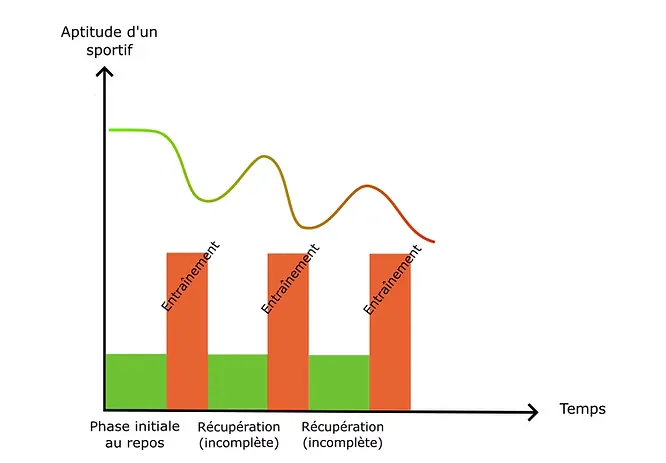
Sleep remains central; a bad night often lowers HRV before any drop in performance. Nutrition, hydration, managing psychological stress and general life balance all play a part too. To avoid excess load, see also our content on overtraining.
What the science actually says about HRV
A decision aid, not a certainty
Interest in HRV is backed by research: it can be more sensitive than resting heart rate for picking up emerging fatigue, and using it to adjust training can produce adaptations equal to or better than a fixed plan, with less risk.
HRV does not directly predict how you will perform today: it is a decision aid, not a crystal ball. Its strength is improving the quality of your steering, not removing uncertainty.
The limits to know before using HRV
Avoiding misreadings
Like any measurement, HRV has its limits. It varies naturally from one person to another and remains sensitive to plenty of outside factors: alcohol, lack of sleep, emotional stress, dehydration, illness, measurement conditions.
Two traps are common: acting on the slightest daily variation, or forgetting the sporting context. A temporary drop after a big block of work can be perfectly logical if it was anticipated and followed by appropriate recovery.
The right approach is to watch the trends, cross-check the signals and use HRV as one indicator among others.
FAQ
Does a low HRV necessarily mean overtraining?
No. It may simply reflect a bad night, a one-off stress, a journey, a recent heavy workout or the beginning of fatigue. It is the persistence of the drop, and how it fits with other signals, that guides the analysis.
Can you have a good workout with a low HRV?
Yes, it happens. HRV on its own forbids nothing. But if it has been low for several days and you feel bad with it, holding on to a big workout usually makes less sense.
Should I look at HRV every day?
Yes, if you want it to be useful. Measuring daily is what builds a personal reference and lets you spot real trends.
Does optical measurement work?
Most watches now offer wrist-based HRV measurement, and there are apps that measure it at your fingertip. Those measurements can give you trends, which will be enough in plenty of cases, but bear in mind that the blood flow measured at the end of your arm is not perfectly in step with your heartbeat. For precise measurement, a device that reads the electrical signal is preferable (we are talking about milliseconds here).
Is HRV only useful to elite athletes?
No. It can be relevant to any endurance athlete who wants to manage the alternation between load and recovery better, and it gets more interesting as training volume rises.
Can a coach bring it in without complicating their follow-up?
Yes, as long as it stays simple: cross-referencing HRV, how the athlete feels, sleep and load is usually enough to guide decisions better.

In summary
What to take away
Heart rate variability is neither a passing fashion nor a gadget. Properly understood, it connects a concrete physiological measure to what really counts: recovery, workout quality and lasting progress.
HRV is most useful when it is measured in stable conditions, compared to a personal reference and read alongside resting heart rate and how you feel. It helps you adjust your training better, without replacing experience, context or common sense.
More articles you might like

The 10 signs of overtraining you need to recognise
Performance dropping, or fatigue that will not lift? Learn to spot the 10 signs of overtraining and recover before the damage sets in.
Getting the most out of training: preventing overtraining with proper monitoring
How to spot overtraining and stay clear of it. Slek can help!

Active recovery: a guide to regenerating better
Understand how active recovery helps your body regenerate after an effort. This complete guide sets out the most reliable methods.