Measuring your athletes’ training load should not require a laboratory or expensive equipment. The Foster method offers a simple approach built on what the athlete actually feels at the end of a workout. By combining the duration of the workout and RPE (the rating of perceived exertion), you can track progress, fatigue and injury risk precisely. Calculating Foster training load sits at the heart of Slek: we use it as the building block for analysing load cycles and helping you programme better. This article demystifies the method, shows how to read the key indicators and gives a concrete example of the kind you will see in Slek.
The Foster method (RPE × duration): calculating Foster training load and reading it
Reading time: ~10 min
Contents
- Understanding the Foster method and load calculation
- Reading training load with the Foster method
- A concrete example of tracking in Slek
- Advantages and limits for coaches
- Using the Foster method with Slek
- FAQ
- Summing up: getting value out of Foster load calculation
Understanding the Foster method and load calculation
Developed in the late 1990s, the Foster method quantifies internal load, meaning what the body actually undergoes. It rests on RPE (Rating of Perceived Exertion), scored from 1 to 10, where 1 is very easy and 10 a maximum effort. Rather than looking only at external data (distance, power), you ask the athlete how the workout felt and multiply that rating by the duration. Used within the 30 minutes after a workout, the method is reliable and correlates with physiological markers of fatigue.
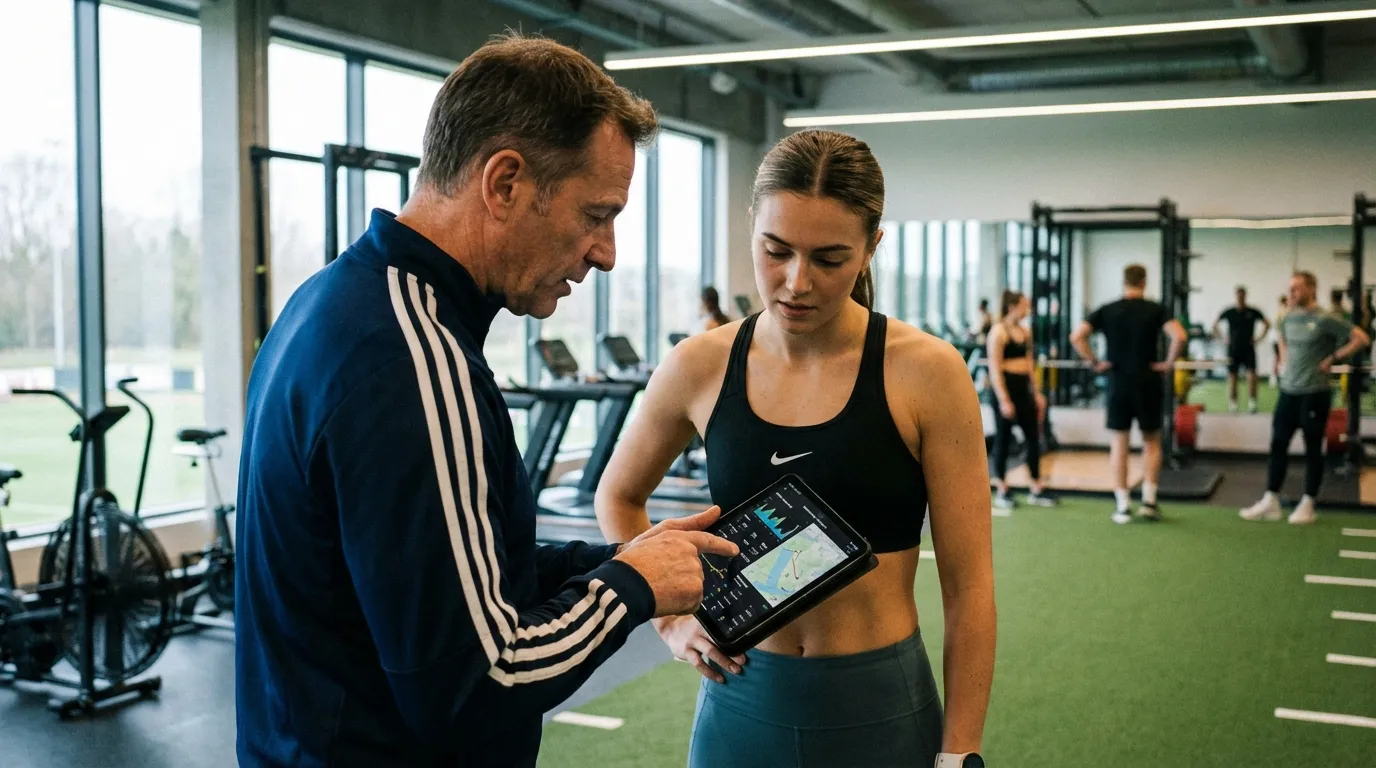
A reminder on RPE and perceived effort
| RPE level | Short description |
|---|---|
| 1 – 2 | Very easy: talking takes no effort |
| 3 – 4 | Easy to moderate: comfortable workout |
| 5 – 6 | Sustained: at ease but focused |
| 7 – 8 | Hard: serious commitment |
| 9 – 10 | Very hard to maximal: very intense workouts or tests |
Ask for the overall RPE around 30 minutes after the workout: too early and the immediate discomfort skews the answer; too late and memory becomes less reliable.
The basic Foster formula
Load for one workout = duration (min) × overall RPE
For example: 50 min at RPE 4 → 50 × 4 = 200 AU (arbitrary units). From there you calculate:
Daily load: the sum of the loads of the day’s workouts.
Weekly load: the sum of the daily loads over 7 days.
Reading training load with the Foster method
The raw load is a first level of information; it gets far more interesting once you derive indicators from it to watch fatigue, injury risk and condition.
Monotony: tracking how even the week is
Monotony = average weekly load ÷ standard deviation of the daily loads.
Monotony > 2 means a high risk of fatigue; > 2.5 means an increased risk of injury.
Acute/chronic ratio (ACWR) for steering progression
ACWR = load over the last 7 days ÷ average load over the last 6 weeks.
Optimal zone: 0.8 – 1.3. Above 1.5: acute overload. Below 0.8: risk of detraining.
A concrete example of tracking in Slek
A typical week for an athlete doing four workouts, with RPE collected at the end of the day.
| Day | Workout | Duration (min) | RPE | Load (AU) |
|---|---|---|---|---|
| Monday | Easy run | 45 | 4 | 180 |
| Tuesday | Intervals | 60 | 7 | 420 |
| Thursday | Strength work | 40 | 5 | 200 |
| Friday | Easy run | 30 | 3 | 90 |
| Saturday | Long run | 80 | 6 | 480 |
Weekly load: 1,370 AU (in Slek we leave the AU out for legibility: it is simply a quantity without a unit, so there is no need to spell it out everywhere).
Monotony ≈ 1.1, a moderate value, consistent with a week that balances heavy days and rest days. In this detailed example, Slek automates these calculations and displays them as charts.
To calculate the mean and the standard deviation, do not forget to include Wednesday and Sunday, which are at zero (plenty of examples you find online, and quite a few apps, leave them out, which throws the analysis off completely).
Advantages and limits for coaches
- Simple in practice: all you need is the duration and one overall RPE.
- Universal: the same calculation works for running, cycling, team sports and strength training.
- An internal view of load: RPE picks up fatigue, stress and motivation.
- Easy to work into software: Slek calculates and displays every indicator automatically.
Limits: it depends on athletes being honest and properly taught; RPE is influenced by heat, sleep and emotion; ideally it should be backed up with objective data (heart rate, power).
Using the Foster method with Slek
1. Explain RPE to your athletes and calibrate the scale with concrete examples.
2. Set up a routine: every workout gets an overall RPE within 30 minutes of finishing.
3. In Slek: let the athlete enter the RPE, then look at the daily and weekly load curves, monotony, strain and ACWR to adjust your programming.
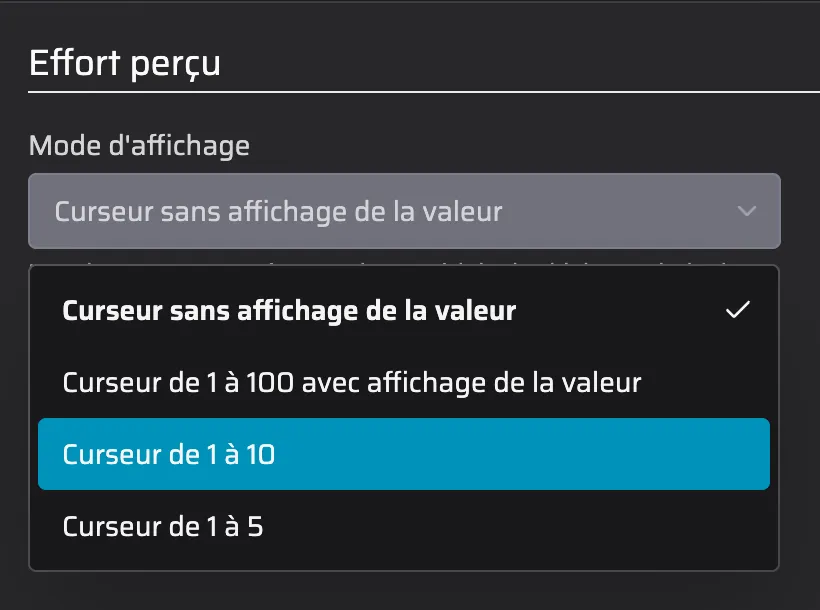
In Slek, RPE is entered by default on a continuous slider with no scale. Studies have shown that this is the best way to limit cognitive bias when someone has to report a feeling. It is then converted to a value between 1 and 10 for the calculations. You can of course go back to the traditional 1 to 10 scale if you prefer, as the screenshot below shows.
FAQ
How does it differ from heart rate monitoring?
Heart rate measures an objective physiological response; the Foster method measures the overall feeling. The two approaches complement each other, and Foster is simpler to roll out across a group because it needs no equipment.
Can the method be used for strength training?
Yes: take the total duration of the session (warm-up included) and ask for one overall RPE covering all the exercises. It is a handy way to follow accumulated fatigue over a block.
How often should I look at monotony and ACWR?
Weekly is generally enough. Slek can show these curves over several weeks or months.
Does the method suit beginners?
Yes, as long as you explain the scale and check regularly that their ratings hang together. The initial aim is for them to learn to listen to how they feel.

Summing up: getting value out of Foster load calculation
The Foster method gives you a simple and powerful frame for turning feelings into data you can work with. Leaning on Foster load, monotony, strain and ACWR, you build safer progressions, limit injury risk and prepare your performance peaks. To move from a home-made spreadsheet to smooth visual tracking, take a look at the Slek app and see how we work this method into everyday life for coaches and their athletes.
More articles you might like

What is RPE | A guide to using it in training
If you take an interest in training, you have certainly wondered what RPE is and why everyone talks about it. This simple rating of perceived exertion has become a central tool in strength and conditioning, in the gym and in endurance sport. It lets you steer intensity day by day, with no sensor, purely from how the effort felt. […]
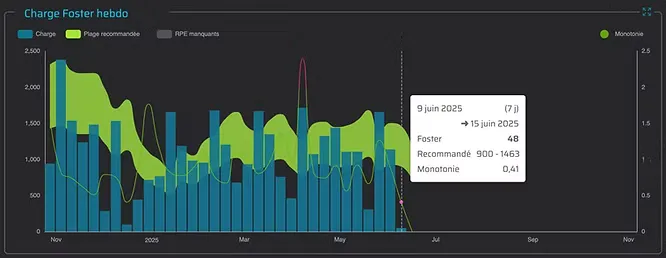
Slek: analysing weekly training load with the Foster method
Training load analysis in Slek, explained from top to bottom.

TRIMP vs Foster: which training load model should you choose?
Amateur or elite, knowing how to dose the intensity of your training is essential if you want to improve without getting injured. Quantifying training load is the tool for that. Among the most widely used methods, TRIMP (Training Impulse) and the Foster model let you […]