If you take an interest in training, you have certainly wondered what RPE is and why everyone talks about it. This simple rating of perceived exertion has become a central tool in strength and conditioning, in the gym and in endurance sport. It lets you steer intensity day by day, with no sensor, purely from how the effort felt. For a coach it is a shared language, one that connects the programme on paper, the athlete’s real condition and the decision to load more or less.
This guide covers how RPE works, how to use it with your athletes in practice, and how to fit it into a modern approach to monitoring, of the kind we offer with Slek.
RPE (Rating of Perceived Exertion): the complete guide to using it in training
Reading time: ~11 min
Contents
- What is RPE and what is it for?
- Understanding the RPE scales and the link with RIR
- How to use RPE in a training programme
- Structuring the use of RPE with your athletes
- Why RPE is so powerful for coaches
- The limits of RPE
- FAQ
- Conclusion
What is RPE and what is it for?
RPE (Rating of Perceived Exertion) is the perceived level of effort. It is a subjective score the athlete gives to the difficulty of an effort, usually on a scale of 1 to 10:
- 1: no effort felt, complete rest
- 10: maximum effort, complete failure, not one more repetition possible
Developed by the psychologist Gunnar Borg in the 1970s (the original scale ran from 6 to 20), RPE let you estimate average heart rate by adding a zero to the figure, so 60 bpm to 200 bpm.
Today the 1-10 scale is preferred because it is more intuitive. The principle has not changed: measure how the effort is experienced, not only what the load or speed figures show. The coach can then check whether the difficulty the athlete felt matches what was planned on paper, and adjust to the shape they are in.
Understanding the RPE scales and the link with RIR
In the gym, RPE is often linked to RIR (Repetitions In Reserve):
| RPE | Estimated RIR | Short description |
|---|---|---|
| 10 | 0 | Complete muscular failure |
| 9 | 1 | One more repetition possible |
| 8 | 2 | Two more repetitions possible |
| 7 | 3 | Demanding but controlled effort |
| 5-6 | 4+ | Moderate effort, good for warming up |
In endurance the logic is similar, but you concentrate on how hard the whole thing feels: RPE 3-5 corresponds to a comfortable pace, while RPE 8 reflects a race pace that is hard to hold for long. Your feel for the scale sharpens with practice, which is why an initial calibration phase matters.
How to use RPE in a training programme
In the gym and in strength work
Most effective sets sit between RPE 7 and 9. “3 sets of 8 repetitions at RPE 8”, for example, means picking a load you could have moved for around 10 repetitions. A lower RPE means the load is too light; RPE 9-10 means it is too heavy. In powerlifting, coaches often distinguish heavy top sets around RPE 8-9, volume work at RPE 6-8 and warm-ups at RPE 5-6.
In endurance, running and trail
RPE guides your pace with no heart rate strap and no watch. One athlete might rate their efforts like this:
RPE 2-3: very easy outing, conversation in full sentences.
RPE 4-5: easy endurance (VT1), shorter sentences.
RPE 7-8: threshold work (VT2), talking becomes difficult.
RPE 9-10: very hard intervals, a few words at most.
As you can see, RPE is a deeply personal number. What matters is being consistent from one day to the next and understanding each other with your coach, not bending yourself to somebody else’s standard.
Over time, if RPE falls for the same pace, your condition is improving; if it rises, it can signal a lack of recovery or the beginning of overtraining.
Structuring the use of RPE with your athletes
Set up an RPE routine
For RPE to become a real steering tool, set up a routine: after every key set or workout, the athlete notes the exercise or the type of workout, the load or pace, the volume (repetitions or duration) and the RPE they felt. This can go in a notebook, a spreadsheet or, of course, an app like Slek that makes the most of it.
Use RPE with more advanced methods
Using RPE opens the door to quantifying load with the Foster method. It also lets you make sure there are moments of recovery in the week, by following the monotony indicator.
Why RPE is so powerful for coaches
- Genuinely individual: you adjust instantly to recovery, sleep or outside constraints.
- It helps prevent overtraining and injury.
- Simple and accessible: no expensive sensor needed, which suits young athletes and amateur clubs.
The limits of RPE
RPE is subjective
RPE remains subjective: beginners often underestimate what failure feels like, the most motivated push past it, and some personalities systematically over- or under-rate their effort.
Reducing perception bias
To reduce those biases: plan 2 to 4 weeks of calibration, cross-check RPE against other indicators (times, heart rate) and go over the vocabulary again regularly.
To limit habit bias (“I always put 3 for this kind of easy run”), Slek records RPE on a continuous scale with no markers by default. You can switch it to the classic 1 to 10 scale if you prefer.
Mixed workouts
The main problem with RPE is how hard it is to rate a mixed workout, or to stay consistent between two workouts that have nothing in common.
An hour of running with just 3 minutes at maximum intensity: do I rate the 3 minutes of intensity or the hour as a whole?
Same question for a very long, easy bike ride: if I finish empty and on my knees even though the intensity never rose, what RPE do I give?
FAQ
Does RPE completely replace load percentages or heart rate?
No, it complements them: plan with percentages or heart rate zones, then adjust to the RPE of the day.
Should I use the 6-20 scale or the 1-10 scale?
For most athletes the 1-10 scale is simpler. The 6-20 scale is not used much any more.
Is RPE useful for beginners?
Yes, with more guidance so they learn to recognise the intensities without going to failure. It also teaches them to listen to how they feel.
How do you fit RPE into a tracking app?
The athlete enters it after the effort, ideally around 30 minutes later. The app then has to let you see the trends and pick out weeks that were too heavy or too light.
Conclusion
Asking what RPE is really means asking what place sensations have in modern training.
Used properly, it lets you tailor the load, protect your athletes’ health and coach with more precision without adding a single sensor.
For simple, centralised monitoring, see how Slek helps you collect and analyse RPE workout after workout.
More articles you might like
Calculating Foster training load: the complete Slek guide
Measuring your athletes' training load should not require a laboratory or expensive equipment. The Foster method offers a simple approach built on what the athlete actually feels at the end of a workout. By combining the duration of the workout and RPE (the rating of perceived exertion), you can track […]
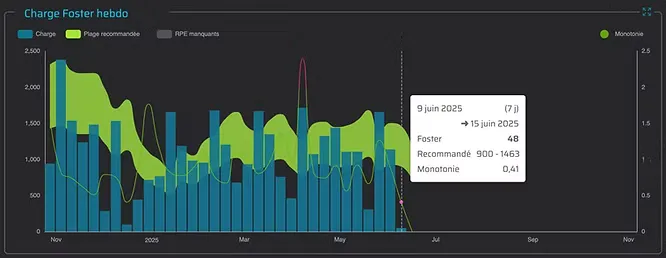
Slek: analysing weekly training load with the Foster method
Training load analysis in Slek, explained from top to bottom.
TRIMP vs Foster: which training load model should you choose?
Amateur or elite, knowing how to dose the intensity of your training is essential if you want to improve without getting injured. Quantifying training load is the tool for that. Among the most widely used methods, TRIMP (Training Impulse) and the Foster model let you […]