The quiet enemy of your progress
You give everything in training, but something is jamming? Fatigue that will not go away, performances heading the wrong way, aches piling up? Time to talk about a nasty trap: training monotony. Too much routine, not enough surprise, and your body wears down instead of improving. So how do you keep overtraining and injury away? Here is the whole story.
What is training monotony?
Carl Foster brought a key indicator to light: training monotony. It is calculated by dividing the average weekly training load by the standard deviation of the daily loads. In other words, it is the ratio between your average training load and how much that load varies.
Put simply, if you repeat the same efforts with little variation in intensity or volume and little recovery, your body only ever adapts to one type of stress, and, more importantly, it gets tired. That is where the trouble starts.
Monotony index too high? Watch out for overtraining and injury
A high monotony index (above 2) encourages the micro-traumas that can turn into serious injuries: tendinitis, stress fractures, muscle tears.
And that is not all. Training that is too repetitive also affects your nervous and hormonal systems. Less recovery, a weakened immune system and a fragile state of mind are all warning signs you should not ignore.
Even if you never reach full overtraining, your efforts will not pay what they should: effective training has to stimulate every component of performance. Too much monotony and you risk hitting a ceiling. Without variation, your body gets no new stimulus and the physiological adaptations slow down.
So vary your training load
Mix easy, moderate and hard workouts across the week. Alternate blocks of heavy load with periods of active recovery so you do not overload.
Rest is part of training, not a break from it. Schedule days off and recovery weeks. Those are the moments when your body rebuilds itself and improves (see the article Getting the most out of training: preventing overtraining with proper monitoring)
Slek, an app for watching your training load and its monotony
Slek is your best ally for keeping an eye on your training load and staying away from monotony. The index now appears on your Foster load charts, and, more unusually, on your TRIMP load charts too (see the article TRIMP vs Foster: which training load model should you choose? )
The higher your index, the greater the risk of overtraining and injury. From 2 upwards you are asking too much of your body, and around 2.5 the risk of injury becomes serious.
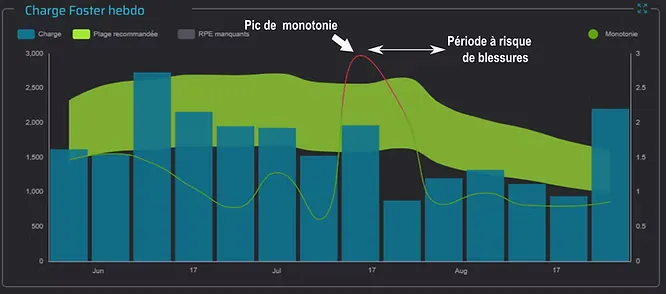
Conclusion: take action
Training is not just stringing workouts together. If you want to avoid injury, keep improving and still enjoy the effort, you have to vary your workouts and respect your recovery cycles. Training monotony is a silent trap, but your Slek app lets you follow the indicator right through the season and adjust your planning when you need to. So if you want to stay clear of injury and keep making progress, now is the time to act.
Create an account and set up training load in your Slek app.
More articles you might like

The 10 signs of overtraining you need to recognise
Performance dropping, or fatigue that will not lift? Learn to spot the 10 signs of overtraining and recover before the damage sets in.

HRV | Heart rate variability and training
Heart rate variability (HRV) has become an increasingly useful reference for understanding what the body is genuinely able to take day to day. It is not about following one more number on a watch or an app: it is above all a way of reading your recovery […]
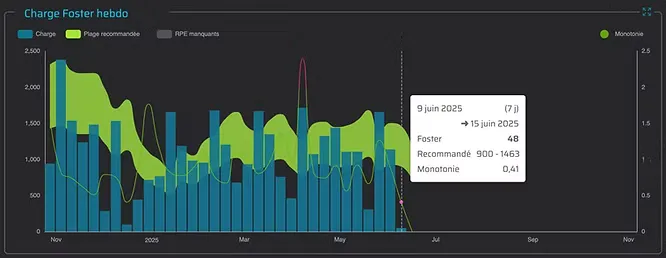
Slek: analysing weekly training load with the Foster method
Training load analysis in Slek, explained from top to bottom.