Running cadence is one of the parameters amateur runners underrate most, whatever they are training for: a half marathon, a trail race or a triathlon. Yet working on your step frequency can turn a shaky technique into a smoother, more economical mechanism that treats your joints better. You do not have to be an elite athlete to benefit: a few gradual adjustments are enough to feel a real difference. Here is how to measure your running cadence, understand what it says about your technique, and improve it without getting injured.
Increasing your running cadence: the simple lever for fewer injuries and faster running
Reading time: ~6 min
Contents
- What is running cadence?
- Why step frequency affects your performance and your injuries
- What is the ideal running cadence?
- How to measure your running cadence
- How to increase your cadence without getting injured
- Do and don’t
- FAQ
- Running cadence, a simple and gradual lever
What is running cadence?
Running cadence is the number of steps you take in a minute, usually expressed as SPM (steps per minute). It is also called step frequency or stride frequency: synonyms for the same biomechanical reality.
The number varies with your level, your build and your pace. Most amateur runners sit between 160 and 170 SPM at a moderate pace. At slower paces it often drops to around 150 to 165 SPM. Elite runners regularly turn over at around 180 SPM, which is often quoted as the theoretical reference. But that figure is not an absolute rule: a tall person will not have the same optimal frequency as a shorter runner, and the same person will have a different cadence running at 6 min/km than at 4 min/km.
Why step frequency affects your performance and your injuries
The link with running economy
A suitable cadence contributes to better running economy, meaning you spend less energy holding a given speed. By raising your step frequency slightly, you tend to shorten your stride, which reduces vertical oscillation (those little bounces that waste energy) and lets you hold a steadier rhythm over long distances. That is particularly useful in a marathon or a triathlon, where managing the effort over time makes all the difference.
The link with reduced impact forces
A common phenomenon among runners with a low cadence is overstriding: the foot lands too far in front of the body, which creates a braking effect (the force points backwards) and transmits considerable impact forces to the knees and hips. Raising your step frequency naturally shortens the stride and brings the point of contact with the ground closer to your centre of gravity. The result: impacts are better absorbed, the joints are asked to do less, and the risk of overuse injuries falls. Shorter, faster and quieter strides are often the sign of a softer, more controlled contact with the ground.
What is the ideal running cadence?
The figure of 180 SPM comes up constantly in conversations between runners. It comes from observations of elite athletes and is a useful reference, but it should not be taken as a universal target. Very solid performances can be produced at other cadences, and chasing 180 SPM at any price without regard for your build or your level can create more problems than it solves.
The right approach is to think in terms of a target range rather than an absolute number. For an amateur runner at a moderate pace, a step frequency around 160 to 170 SPM is common. Working gradually towards 170 to 180 SPM can improve your technique and reduce impact, as long as you go in stages and listen to how it feels. Your optimal cadence depends on your height, your mobility, your level and your running speed.
How to measure your running cadence
The manual method
You do not need sophisticated equipment to start. Here is the simplest method.
Start a stopwatch and run at your usual rhythm for 60 seconds. Count how many times your left (or right) foot touches the ground, then multiply by 2. If you count 84 left foot contacts, your cadence is 168 SPM. You can also work over 30 seconds and multiply by 4 for the same result. For a more reliable figure, repeat the exercise over several stretches and take an average.
Digital tools
The vast majority of GPS watches (Garmin, Polar, Coros, Suunto and Apple Watch) display cadence in real time or in the statistics after a workout. That is the most practical way of following how your step frequency changes across your training. External footpods give an even more precise measurement. Some coaches also use video on a treadmill to analyse technique and count foot strikes frame by frame.
How to increase your cadence without getting injured
The 5% rule
The golden rule is gradual progression. Raising your cadence by more than 5 to 10% at once exposes you to muscle pain and overuse injuries, because your body has to adapt its tendons, its muscles and its neuromuscular patterns. The recommended method is to set a first step at 5% above your current cadence. If you run at 160 SPM, you aim at 168 SPM, no more. You work at that new frequency over parts of your usual workouts, at a comfortable pace. Once you can run 5 km holding that cadence easily, you can consider the next step.
Using a metronome or a playlist
A metronome set to your target cadence is a very effective tool for anchoring the new rhythm. You synchronise each step with the beeps, which lets your brain take the new frequency in gradually. A more pleasant alternative is a playlist of tracks at 170 or 180 BPM: one step per beat. Plenty of music and running apps offer playlists sorted by BPM, which makes the exercise easier.
Adjusting your stride technique
Increasing cadence is not just about moving your legs faster. You also have to adjust the technique so the change lasts and does you good. Concentrate on shorter, faster steps, keeping your feet under you rather than far in front. Try to run more quietly: less impact noise means a softer contact with the ground. Bring stretches at a higher cadence into your usual easy runs rather than trying to hold the new frequency for the whole outing from day one.

Do and don’t
| Do | Don’t |
|---|---|
| Measure your current cadence. | Do not chase 180 SPM immediately. |
| Increase in steps of 5% maximum. | Do not work on cadence while ignoring your volume and your pace. |
| Use a metronome or a playlist. | Do not skip the warm-up. |
| Step back if you feel tension or pain. | Do not keep pushing if your technique degrades or a pain appears. |
FAQ
Is running cadence different on trail and on road?
On trail, cadence varies more with the terrain: climbs and technical descents demand constant adaptation. Going down, a higher cadence with short steps lets you handle the irregularities of the ground better and reduces impact, while going up the cadence often slows naturally. On the road, cadence is generally more stable. In both cases the principles of gradual improvement are the same.
Does cadence change with speed?
Yes, entirely. The faster you run, the more your cadence naturally rises. At a slow pace it is normal to have a lower step frequency. The aim is not to have the same cadence at every pace, but to avoid dropping too far below 160 SPM even on easy outings, which would usually be a sign of overstriding.
How long does it take to raise your cadence for good?
There is no universal timescale, but most runners see a gradual adaptation over four to eight weeks of regular work. The change has to be conscious and guided first (with a metronome or a playlist) before it becomes automatic. Consistency is the key: a few minutes in every workout beats one intensive session a week.
My watch says my cadence is 80!
No need to worry: some watches (Suunto, for instance) show revolutions per minute rather than steps. They count cycles, meaning how many times the left (or right) foot touches the ground per minute. If it says 80, you are at 160 SPM.
That way of counting is closer to what is measured in cycling, where you count crank revolutions per minute, and where the target values end up being similar: 80 to 90 revolutions per minute, with some riders spinning more than others.
Running cadence, a simple and gradual lever
Working on your running cadence means investing in a technical lever that acts on performance and injury prevention at the same time. By measuring your current step frequency, setting realistic steps of 5% and adjusting your technique bit by bit, you build a running mechanism that is more efficient and lasts longer. That is exactly the kind of measurable, structured progress Slek lets you follow across your training, so that every number becomes a concrete lever for improvement.
More articles you might like

How joint mobility improves your stride
Find out how 10 minutes of joint mobility a day can improve your stride, and the essential exercises for running better and limiting injuries.
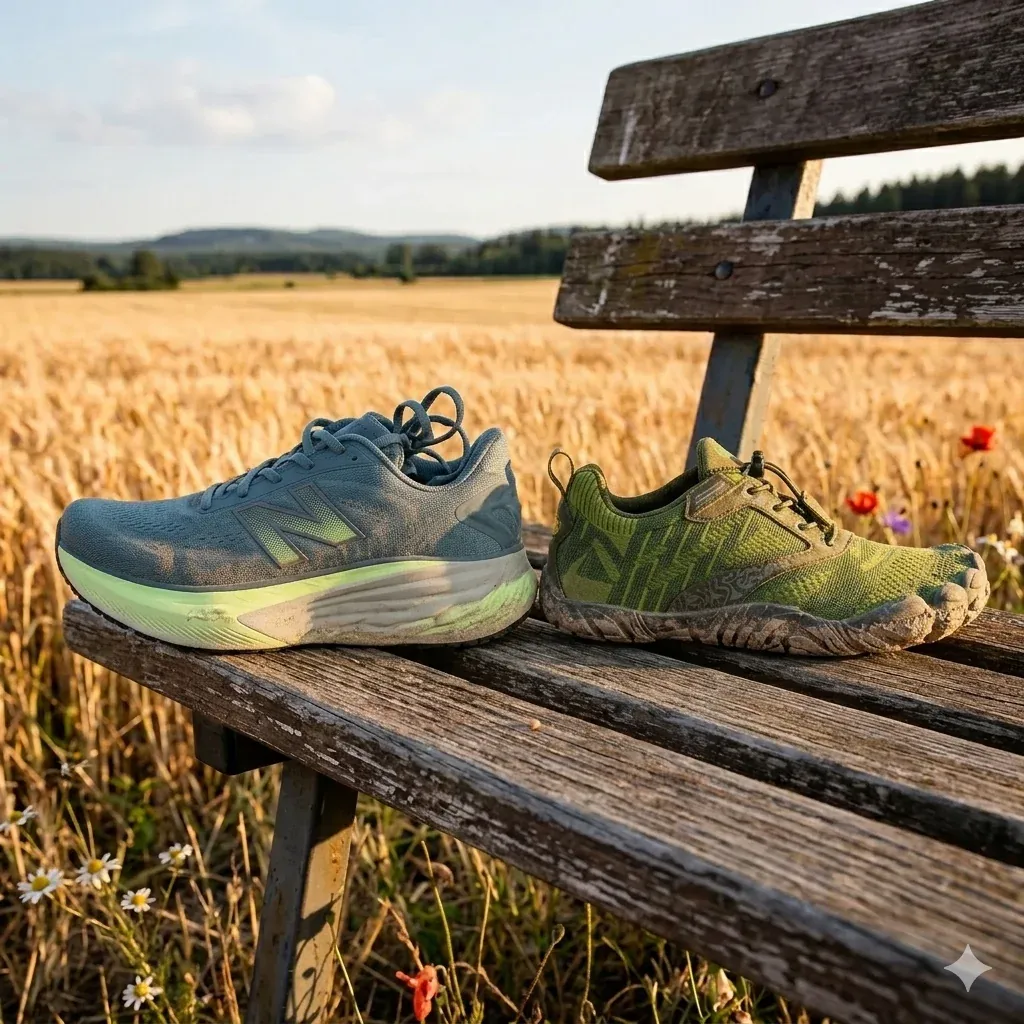
Minimalist running shoes: making the right choice
Minimalist or maximalist: compare the two running shoe philosophies, their benefits and their risks, and find the right choice for your profile so you can improve without getting injured.

Planning your return to training after a break: the 4-step guide
Planning your return after a break is rarely as simple as it looks. After a holiday, an injury, a dip in motivation or a forced pause, we usually want to get back quickly and find our feel again. That is exactly when the mistakes pile up: restarting for good needs a clear, gradual, realistic frame. […]