An introduction to minimalist running shoes and their maximalist alternatives, to help you make the right choice.
Minimalist or maximalist running shoes: which to choose to improve without getting injured?
Reading time: ~6 min
- What is a minimalist running shoe?
- Minimalist vs maximalist: an objective comparison
- The real benefits of minimalist running
- The limits and risks you should not ignore
- Which runner does each shoe suit?
- How to make the transition to minimalist shoes
- Choosing minimalist shoes: the criteria that actually matter
- Minimalist or maximalist: the right choice for your profile
- FAQ
Minimalist or maximalist: the debate has been stirring the running community for years, and it is far from settled. Between the promise of a more natural stride and the comfort of generous cushioning, both philosophies have their convinced followers and their equally determined critics. The reality is more nuanced: the right choice depends on your profile, your injury history and the way you train your body. This article offers an objective comparison of minimalist running shoes and their maximalist alternatives, so you can decide with your eyes open.
What is a minimalist running shoe?
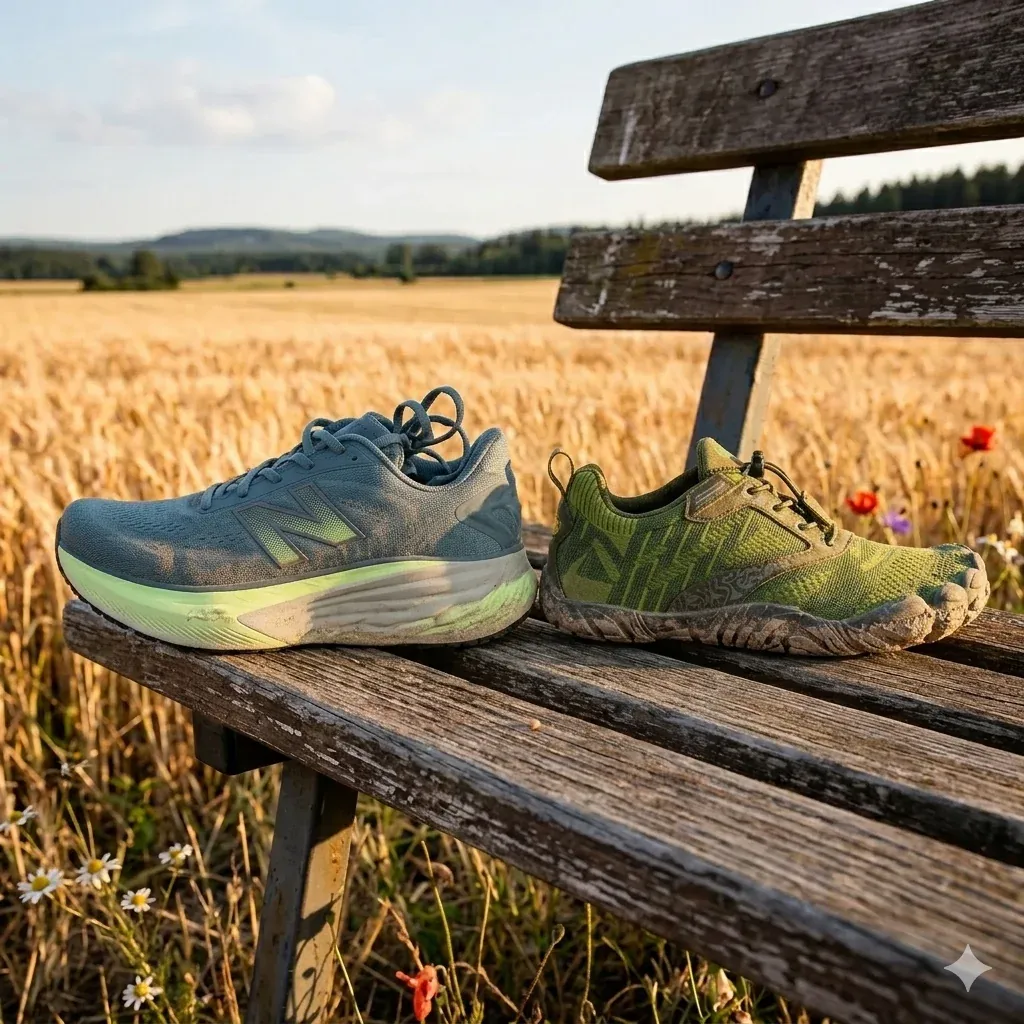
A minimalist running shoe is designed to come as close as possible to the feeling of running barefoot, while offering basic protection against what is underfoot. It is defined by four fundamental technical characteristics.
The drop is low or zero, between 0 and 4 mm. That almost non-existent height difference between heel and forefoot naturally pushes you towards a midfoot or forefoot strike, considered closer to a natural stride. The sole is thin, with no bulky cushioning systems or pronation control, which lets the foot “work” and feel the ground directly. The weight is very light, often under 250 grams per shoe, and flexibility is maximal: the shoe bends in every direction with no noticeable resistance. Some models also have a wider toe box, letting the toes spread and take an active part in stabilising each foot strike.
This philosophy belongs to the “natural running” movement, which holds that the human foot is, originally, perfectly adapted to running with no technological assistance.
Minimalist vs maximalist: an objective comparison
To choose, you first have to understand what concretely separates the two approaches, beyond the marketing arguments.
| Criterion | Minimalist shoe | Maximalist shoe |
|---|---|---|
| Drop | 0 to 4 mm | 6 to 12 mm (or more) |
| Sole | Thin, flexible, little cushioning | Thick, rigid, heavy cushioning |
| Weight | Very light (often < 250 g) | Heavier |
| Stride encouraged | Midfoot or forefoot | Heel strike made easier |
| Proprioception | High | Reduced |
| Stress areas | Foot, Achilles tendon, calf | Knee, hip, back |
| Suits | Experienced runner, transitioning gradually | Long distances, runners looking for comfort |
This table illustrates a point that is often misunderstood: neither type of shoe removes the mechanical demands, they move them. A maximalist shoe reduces the stress on the foot and the Achilles tendon, but potentially increases it on the knee, the hip and the lower back. A minimalist running shoe does the opposite. There is no miracle solution, only different compromises depending on your anatomy and your training habits.
The real benefits of minimalist running
Better proprioception and more sensory feedback
The thin sole of minimalist shoes lets the foot pick up information from the ground directly: texture, camber, irregularities. That improved proprioception encourages finer, faster biomechanical adjustments with each stride. Plenty of runners describe a feeling of lightness and freedom, as though the shoe “disappeared” to leave room for the movement.
More complete muscular work
By asking more of the muscular and tendinous system of the foot, the ankle and the calf, running in minimalist shoes acts as training in itself. The foot, often under-stimulated in heavily assisted shoes, gets an active role back in absorbing impact and in propulsion. Over the long term that can help strengthen areas often neglected in classic training programmes.
A potentially more efficient stride
A zero or very low drop encourages a midfoot or forefoot strike, which reduces the braking effect characteristic of heel striking. That change of stride, combined with better overall posture, can improve running economy, meaning the amount of energy spent to hold a given pace.
Want to go further with your progress? See how Slek helps you structure your endurance training.
The limits and risks you should not ignore
The myth of the shoe that “prevents” injuries
There is no solid evidence that running in minimalist shoes causes more injuries than running in classic shoes, but the reverse is not proven either. The injuries reported among minimalist converts are largely attributed to transitions made too fast, not to the shoe itself. So the problem is not the philosophy, it is impatience.
The Achilles tendon and the calf on the front line
When the transition is rushed, mechanical stress rises sharply on the foot, the Achilles tendon and the calf, areas not used to working that hard. The risk of a stress fracture, Achilles tendinitis or muscular cramping is real if your minimalist volume rises too quickly.
Profiles that need to be careful
Some runners really should see a health professional before considering a transition to light, low-drop shoes:
- A history of Achilles tendinitis, plantar fasciitis or stress fractures in the foot.
- Significant excess weight combined with a high training volume.
- Beginners with less than a year of regular running.

Which runner does each shoe suit?
The beginner
For someone starting out in running, a classic or lightly cushioned shoe remains the most cautious recommendation. The foot, the calf and the Achilles tendon have not yet developed the strength needed to absorb the demands of a thin sole. Gradually introducing short workouts in minimalist shoes, after a few months of running, is a sensible way to start strengthening those structures.
The experienced runner working on technique
This is the profile that gets the most out of light, low-drop running shoes. Using them for technical workouts, short intervals or specific strength work improves the stride without exposing the body to excessive stress on long runs.
The performance-oriented runner
Experts and physiotherapists specialising in sports biomechanics often recommend a multi-pair approach: a carbon-plated shoe for races and speed workouts, a cushioned shoe for long volume outings, and a minimalist or neutral shoe for strength workouts and technical work. That rotation gets the benefit of each type of shoe while limiting the areas that get overworked.
How to make the transition to minimalist shoes
The golden rule is simple: the longer you have run in traditional shoes, the slower your transition has to be. The body needs time to adapt to a radically different pattern of demands.
A gradual approach recommended by specialists runs in three stages. Start with 10 to 20 minutes of brisk walking in minimalist shoes to get the foot used to them without any impact. Then bring 5-minute segments of running in minimalist shoes into the middle of a usual outing in classic shoes. Increase the length of those segments very gradually according to how it feels, and never push if an unusual pain appears in the foot, the calf or the Achilles tendon.
Alongside that, two technical exercises speed up the adaptation. Running uphill naturally favours a forefoot strike, because heel striking is almost impossible in that configuration. Working on a silent landing, trying to make as little noise as possible on contact with the ground, improves the quality of your foot placement and reduces impact. Specific calf and foot strengthening (calf raises, jumps, single-leg work) rounds off the transition effectively.
Choosing minimalist shoes: the criteria that actually matter
Not all models are equal, and the level of minimalism varies considerably from one pair to another. For a transition, an “intermediate” model with a drop of 4 to 6 mm and a little cushioning is often more suitable than a “full minimalist” model with zero drop and almost no sole. Fit is crucial too: the shoe should wrap the foot without compressing it, leaving the toes free to spread. Finally, what you use them for guides the choice: road, trail, track and gym work do not involve the same surfaces or the same intensities.
Minimalist or maximalist: the right choice for your profile
Choosing between minimalist and maximalist running shoes is not a question of fashion but of coherence between your kit, your level and your objectives. Minimalism offers real benefits in proprioception, muscular work and stride quality, as long as you respect a rigorous, gradual transition. Maximalism answers other needs, particularly over long distances or for more fragile profiles. The best strategy, often, is not to choose between the two but to alternate intelligently according to the type of workout. To structure that training and follow your progress without getting injured, Slek is there for your endurance training day to day.
FAQ
Do minimalist running shoes suit beginners?
For someone starting out in running, a classic or lightly cushioned shoe remains the most cautious recommendation. Minimalist running shoes can be introduced later, through very short and gradual workouts, so as to strengthen the foot, the calf and the Achilles tendon without overloading them.
Do minimalist running shoes reduce the risk of injury?
There is no solid evidence that minimalist running shoes cause more or fewer injuries than classic models. In practice, most injuries occur when the transition is too fast, because the stress moves to the foot, the Achilles tendon and the calf. Slow, controlled progression therefore remains essential.
How do you make the transition to minimalist running shoes successfully?
The transition to minimalist running shoes has to be slow and gradual, especially if you have run in traditional shoes for a long time. Starting with brisk walking, then bringing short running segments in minimalist shoes into your usual outings while watching for pain in the foot, the calf or the Achilles tendon, lets the body adapt step by step.
More articles you might like
How joint mobility improves your stride
Find out how 10 minutes of joint mobility a day can improve your stride, and the essential exercises for running better and limiting injuries.
A practical guide to increasing your running cadence
Find out how to increase your running cadence step by step. Follow our practical advice to run faster and stay clear of injury.

Planning your return to training after a break: the 4-step guide
Planning your return after a break is rarely as simple as it looks. After a holiday, an injury, a dip in motivation or a forced pause, we usually want to get back quickly and find our feel again. That is exactly when the mistakes pile up: restarting for good needs a clear, gradual, realistic frame. […]