Getting the most out of training: preventing overtraining with proper monitoring
We live in a culture that celebrates performance and treats pushing past your limits as the norm. Amateur or professional, an athlete is constantly pushed to go further and harder. Whether it is to beat a personal best, to meet other people’s expectations or to chase a private idea of perfection, the belief that you always need “more” has settled deep in sport.
That mindset is not without risk. Xavier Grenier-Talavéra, a Canadian triathlete and former national team member, has described his own experience of overtraining syndrome [1], and what it did to him physically and psychologically.
1. What is overtraining?
Overtraining (n.): “excessive training that exhausts you and makes you lose fitness”, to paraphrase the Larousse dictionary [2].
The human body is resilient, but it has limits. Cross them without giving it time to recover and you enter dangerous territory. Pile up intense workouts, skip the rest, and overtraining creeps in, damaging not just your performances but your physical and mental health.
Overtraining affects a great many athletes, and you certainly do not have to be an elite to be concerned. A study by Morgan et al. (1987 and 1988) [3] found that roughly two thirds of middle-distance and distance runners have suffered, or will suffer, from overtraining at least once in their career.
It comes from an imbalance between training, recovery and other outside factors. Understanding how it shows up, where it comes from and how to prevent it is essential if you want to keep performing and stay healthy.
After a hard effort, the body needs time to recover and adapt (a process called supercompensation) before performance improves.
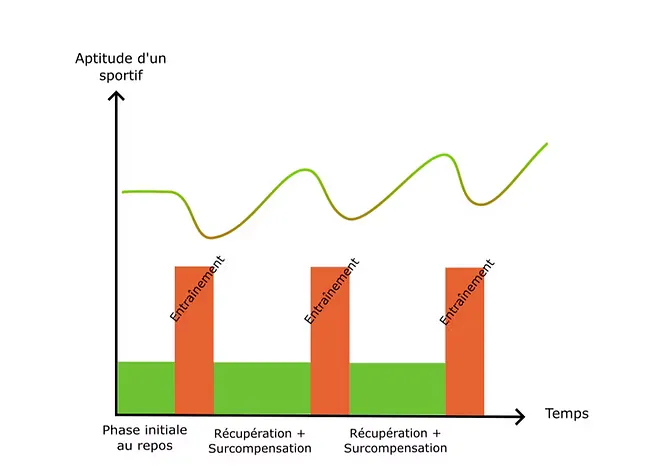
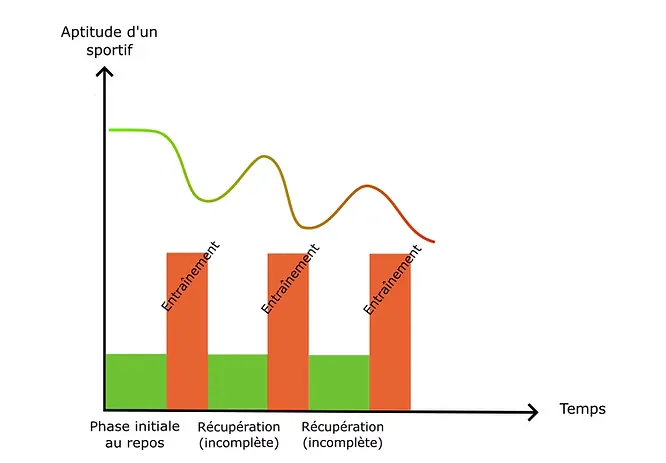
If the rest periods are too short, or if intensity rises too quickly, fatigue accumulates and the body cannot regenerate. Capacity then falls back, and this can lead to overtraining, with real consequences for health and performance.
2. The symptoms and causes of overtraining
The signs of overtraining vary, and they are both physical and mental. Paradoxically, elite athletes, who train with technical, physiological and medical support, are less exposed than ambitious and highly motivated athletes with less supervision and follow-up.
The following symptoms are often seen in people who may be overtrained (although each can also have other causes): fatigue that persists despite rest, a drop in physical performance, disturbed sleep, a raised resting heart rate, a tendency to pick up every infection, and mood swings such as irritability or a loss of motivation. Several scientific papers and theses cover these symptoms in detail and are well worth reading.
Overtraining can have several causes. Training load (volume or intensity) can rise too far without a progressive build-up, or the recovery periods can simply be too short. External factors play their part too: work, personal relationships or other commitments can all lead to exhaustion. On top of that, a diet that does not cover your energy needs can lead to overtraining syndrome, as explained in the thesis “Analyse des pratiques sportives et évaluation rétrospective de l’incidence des principaux symptômes associés au syndrome du RED-S (déficit énergétique relatif au sport) chez une population de coureur” by Dr Edouard Stavaux [5] (well worth a read).
3. How do you avoid overtraining?
During intensive training, tracking changes in mood alongside physiological markers (heart rate, muscle glycogen, testosterone and others) has long been used to judge how training load affects an athlete’s psychology [6].
INSEP stresses how important it is to monitor training load and to recognise the early warning signs of overtraining [7]. To avoid it, plan regular rest: build rest days and recovery weeks into the programme. A balanced diet matters just as much, with enough nutrients to support both the effort and the recovery.
The single most useful thing, though, is learning to listen to your body: pay attention to the signals of fatigue and adjust training accordingly.
The information presented here comes from several sources and deserves to be read in context. Each study or account reflects one specific reality, and there may be nuances or limitations that this article does not fully cover. We encourage you to read the original work and publications to deepen your understanding of the subject.
A FEW REFERENCES:
[1] “SURENTRAÎNEMENT, BURNOUT ET DÉPRESSION”, ROMAIN GARCIN. Accessed 23 January 2025. [Online]. Available at: https://garcinromain.com/surentrainement-burnout-et-depression/
[2] É. Larousse, “Définitions : surentraînement – Dictionnaire de français Larousse”. Accessed 23 January 2025. [Online]. Available at: https://www.larousse.fr/dictionnaires/francais/surentra%C3%AEnement/75670
[3] G. Cazorla, “Université Victor Segalen Bordeaux 2 : Laboratoire Evaluation Sport Santé.”.
[4] “Cyclisme : Quel est l’intérêt de la coupure ?”, Lepape-Info. Accessed 23 January 2025. [Online]. Available at: https://www.lepape-info.com/entrainement/entrainement-cyclisme/quel-est-linteret-de-la-coupure/
[5] “Memoire-RED-S-Dr-STAVAUX.pdf”. Accessed 23 January 2025. [Online]. Available at: https://surentrainement.fr/wp-content/uploads/2023/10/Memoire-RED-S-Dr-STAVAUX.pdf
[6] “Un instant…”. Accessed 23 January 2025. [Online]. Available at: https://www.researchgate.net/profile/Johan-Cassirame/publication/310572807_Le_suivi_du_surentrainement_Exemple_du_pole_d’Evry/links/5831adb208ae004f74c2a4c0/Le-suivi-du-surentrainement-Exemple-du-pole-dEvry.pdf
[7] P. Fleurance, “Comment analyser le syndrome de surentraînement pour en prédire l’apparition ?”, presented at the Congrès international de la Société française de psychologie du sport, July 2000. Accessed 23 January 2025. [Online]. Available at: https://insep.hal.science/hal-02492729
More articles you might like
The 10 signs of overtraining you need to recognise
Performance dropping, or fatigue that will not lift? Learn to spot the 10 signs of overtraining and recover before the damage sets in.

HRV | Heart rate variability and training
Heart rate variability (HRV) has become an increasingly useful reference for understanding what the body is genuinely able to take day to day. It is not about following one more number on a watch or an app: it is above all a way of reading your recovery […]

Active recovery: a guide to regenerating better
Understand how active recovery helps your body regenerate after an effort. This complete guide sets out the most reliable methods.