If you want to reach your goals, every workout counts. But when you are ill, and it might be a simple cold, flu or a more complicated viral infection, the question comes up: should you carry on training anyway?
Plenty of athletes are afraid of “losing fitness” or “missing their peak”. Yet carrying on training while ill is not proof of discipline. It is taking an enormous risk.
The (almost) invisible danger: hard training plus infection
When you fall ill, your body is already fighting to clear the virus or the bacterium. Adding training on top is like pulling harder on a bowstring that is already drawn tight.
As you know, the heart is a muscle. Every workout asks something of it, which makes it more fragile during an infection. Add a heavy load and the virus or bacterium (usually a virus in this case) tends to reach the heart muscle. That can cause heart rhythm disorders and sometimes even sudden death.
The relationship between sport and immunity
Most of us know that moderate, regular exercise appears to strengthen the immune system. Push your body to the extreme, though, especially while ill, and you create a state in which immunity drops sharply. The result: more risk of making a virus worse or of catching another infection. In elite athletes, already under colossal loads, that state is wider and riskier still. The phenomenon can be illustrated with a J-shaped diagram, brought to light by the work of David Nieman and colleagues.
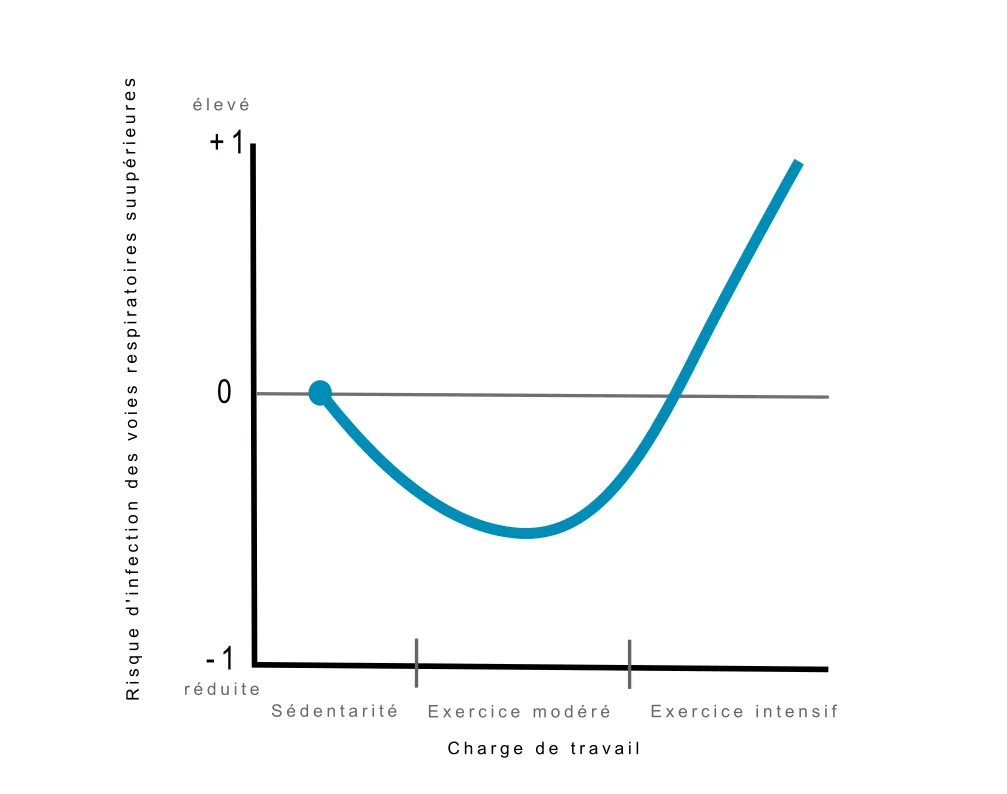
During sedentary or light activity (to the left of the chart), the immune system gets little stimulation and the risk of infection is higher, which is typical of an inactive life. If you are reading this, though, I doubt inactivity is your problem.
For someone taking moderate exercise (the bottom of the J), the line representing the risk of catching an upper respiratory tract infection drops. That corresponds to better immunity.
With intense or prolonged exercise (to the right, going up the J), the risk climbs back to normal and then past it, which increases the risk of infection.
Hard efforts can therefore bring about:
- A temporary fall in immune cells (lymphocytes and others),
- A drop in immunoglobulins,
- More inflammation, fatigue and oxidative stress after the effort. That is what creates a window of increased vulnerability to infection in the hours after training.
How is it, then, that elite athletes are not ill all the time? Some research suggests that in professional athletes the model may shift towards a flattened S shape: they would have developed better immune resilience, which slightly changes the dynamics of infection risk.
I am ill: when do I stop training?
There is a small rule of thumb for deciding whether training is sensible. If the symptoms are above the neck (blocked nose, scratchy throat, sneezing), light activity is generally fine: an easy bike ride, a gentle run, yoga, calm swimming. But if the symptoms are below the neck (a productive cough, unusual muscle pain, fever), stop completely. Pushing through risks a prolonged infection, or worse.
And once the infection is over, it matters that you build back gradually and watch how you feel (your heart rate can be a good indicator too).
That said, the best thing to do when an infection drags on is to see your doctor and get treated.
Conclusion
For an athlete, stopping can feel unnatural. Yet it is sometimes the most professional choice you can make. Better to lose three days of training than three months of the season, or worse, a whole career.
Discipline is not always about stringing workouts together. It is also about respecting your body and giving it time to heal.
A quick summary:
-
Symptoms above the neck: light training is possible
-
Symptoms below the neck: COMPLETE REST (especially with a fever, to avoid more serious complications)
Your body is still your best ally for enjoying yourself and performing. Look after it.
(this one is a quote from the Slek team ;))
More articles you might like

The annual off-season break | When and how to plan it
The annual break is one of those subjects that divides people almost as much as it reassures them. Some see it as essential to lasting; others live it as a step backwards or a loss of level. Yet among endurance athletes the signals broadly point the same way: a planned pause often helps you recover better, […]
The 10 signs of overtraining you need to recognise
Performance dropping, or fatigue that will not lift? Learn to spot the 10 signs of overtraining and recover before the damage sets in.

Active recovery: a guide to regenerating better
Understand how active recovery helps your body regenerate after an effort. This complete guide sets out the most reliable methods.