You run in the mountains, you love technical paths, big climbs and wild scenery, but you also want to improve, stay clear of injury and, above all, get your next trail race right. From a local 20 km to finishing UTMB, here is why Slek is an indispensable ally for reaching your goals in trail running.
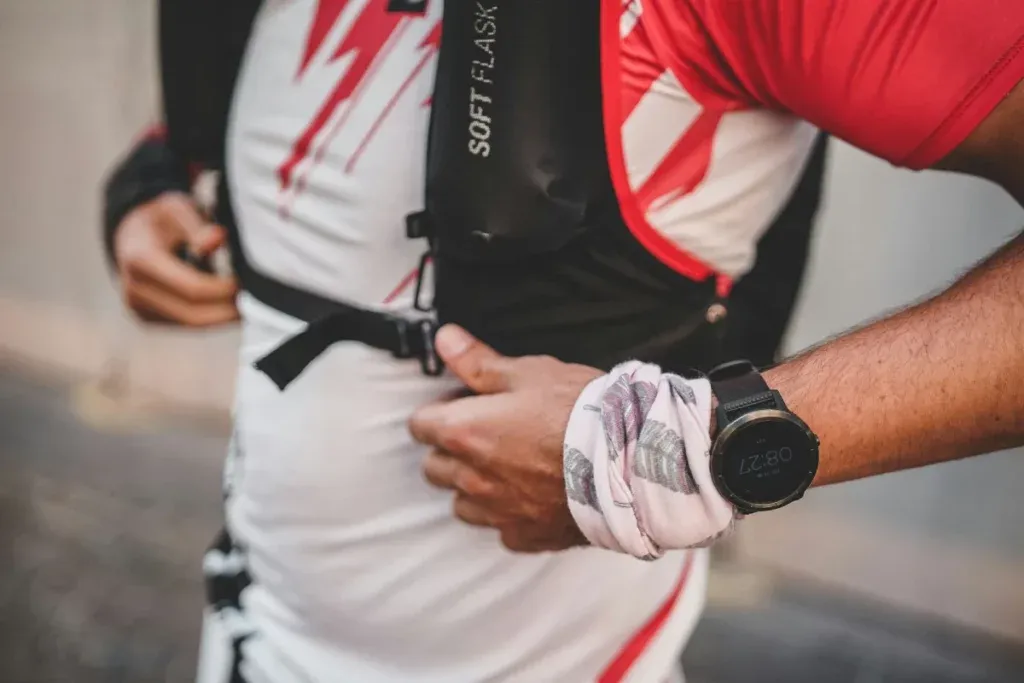
In trail running, kilometres are not the only thing that counts
In trail running it is not enough to measure distance or finishing time. You also have to track elevation and gradient, and of course your heart rate or your power.
With Slek you can:
- Record all of it automatically (if you have a watch and the right sensors).
- See it at particular points on your route (climbs, descents) and put it in context on a map.
- Analyse your performances and follow your indicators, grouping your different types of outing together or keeping them apart (road, trail, track).
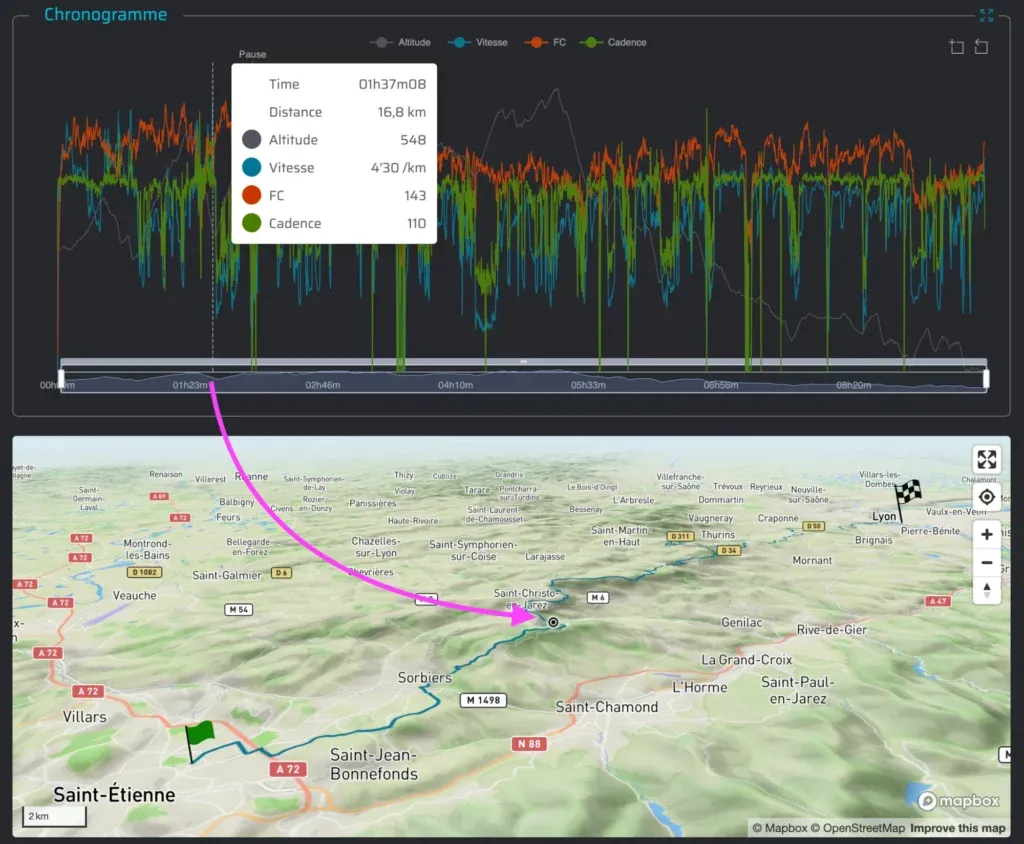
A map of your route lets you put the data recorded by your watch back into context. Here, the Sainté Lyon course
Managing fatigue precisely to keep overtraining and injury away
Trail running is a demanding endurance sport and injuries, unfortunately, are common. Slek gives you precise indicators for watching your fatigue and your training load: load analysis with the Foster or TRIMP methods, monotony calculation and more. That data lets you adjust your plan as you go, avoid overloading, and reach the start line in good shape
Building periodization into your plan to improve in trail running
Trail running is not track running. You climb, you descend, you jump, you adapt to the ground, and every one of those is a physical quality to work on. That is exactly why giving your training structure through periodization is not a luxury. It is the key to improving, staying healthy and reaching your goals without burning out. In short, once you have set your objectives (Diagonale des Fous, the Saint-Héand trail race), you split your preparation into periods (transition, general preparation, specific preparation, competition), each aiming at one precise objective.
Why does that matter so much in trail running?
1. You cannot do everything at once.
You cannot run 30 km with 2,000 m of climbing and do uphill intervals and work on technical descending and recover, all in the same week.
Periodization lets you put your energy into what counts, at the right moment.
For example: in January you build volume in easy endurance. In March you add long climbs. In May you simulate your target race. At the end of June you sharpen up before race day.
2. You avoid overload and injury
Without periodization, you risk running too hard, too often, without recovering. The result: tendinitis, waves of fatigue, loss of motivation.
Periodization builds in weeks of active recovery, reductions in volume and deload phases, so that you can keep improving.
3. You arrive on the day in the best shape possible
Periodization lets you build up gradually, then drop the intensity 1 to 2 weeks before your race so your body is fresh, your head is in it and your legs are ready to take the kilometres.
4. You adapt to your course
Running a race in the mountains? Periodization lets you concentrate on the efforts that matter: long climbs, fast descents, technical sections.
5. You improve over the long term
Without periodization, you stagnate. With it, you gain endurance, power and efficiency year after year. You go from 20 km to 50 km, from 1,000 m to 3,000 m of climbing, with much less risk of injury.
Slek can help you:
- Build a season plan very easily
- Check, as you plan your week, that the load you have planned is consistent with your season plan and the shape you are in (planned load and ACWR calculation).
- Track the load you actually complete and check it against the load you planned.
To find out how periodization can help you reach your trail running goals, look here.
Staying motivated all year round
A rainy January, short days, muddy paths, and you catch yourself thinking “what is the point?”
Slek is not only a planning tool. It is also what keeps you going, 365 days a year.
1. You have objectives, not just workouts
Without Slek you tell yourself: “I’ll go for a run when I have time.”
Once your planning is done, Slek gives you a clear schedule:
- Monday: active recovery
- Wednesday: hill session
- Saturday: long run
- Sunday: rest
You no longer have to think about it. You open the app, you see what you have to do, and you do it. You are not “running for the sake of running” any more, you are building something. It also helps you accept rest days without feeling guilty: rest is where the progress happens.
2. You see your progress, even when you cannot feel it
In trail running, progress is slow and invisible. You do not take 10 seconds off your 100 m; you take 5 minutes off a 20 km in the mountains.
Slek shows it to you:
- Your cumulative elevation is rising
- Your time on a fixed route is falling
- Your weekly volume is growing
In short, you can see that you are moving forward, which is concrete proof that you are not wasting your time.
To sum up, Slek gives you a clear frame, realistic objectives and precise tracking. You save time, you avoid mistakes, and you reach the start of your race fit and confident.
More articles you might like

Reverse periodization for trail: principles and benefits
Reverse periodization for trail running is drawing more and more interest from coaches and runners who want to structure their preparation better. Unlike the classic model, it starts by developing intensity before gradually increasing volume. On paper the idea is attractive, particularly in trail and ultra-trail where winter often makes long outings difficult. But […]
A step-by-step guide to preparing your first triathlon
Distance, kit, an 8-week training plan, transitions: follow this step-by-step guide to prepare your first triathlon calmly and avoid the beginner's mistakes.

Getting hill training right, step by step
Find out how to fit hill training into your routine. Follow this step-by-step guide to build power and avoid the classic mistakes.